UNITED STATES GOVERNMENT DRUG TRAFFICKING
By Daniel Beck
November 2021
Disclaimer
The purpose of this paper is to examine actions of United States government officials and/or agencies, according to official and mainstream media sources, for failures or potential failures to perform one or more of the following:
1. Properly execute justice
2. Operate with reasonable transparency
3. Appropriately address instances of dereliction of duty
4. Appropriately address instances of corruption
Every detail found in each section can also be found in one or more of the sources listed at the end of that section. Meaningful rebuttals, counter-rebuttals, etc., to the main points covered in this paper have been included to the best of my ability and awareness.
This paper does not assert that every detail of every section is true. In fact, every detail cannot possibly be true since some details contradict others. This paper also does not assert that all sources cited espouse the overall narrative of their sections or the paper as a whole. In fact, occasionally sources cited are skeptical or derisive of said narratives.
The method of research used for developing this paper has been called “open-source intelligence” because intelligence agencies develop most of their insights by searching through publicly available repositories of information. In the 2006 film, “9/11 Press for Truth,” which documents the creation of the 9/11 Commission, veteran CIA analyst Ray McGovern stated:
“The whole mystique of intelligence is that you acquire this very valuable information covertly. [However] if the truth be told, about 80 percent of the information that one needs is available in open-source materials.”
Open-source intelligence involves accumulating seemingly unrelated or loosely related data points from articles/books which are often given low priority/visibility in daily news cycles. However, once assembled they can form accurate narratives that may differ greatly from narratives being promoted by a given country’s government.
This paper contains copyrighted material such as media excerpts that have not been specifically authorized by the copyright owner. This material is included to advance the education of criminal justice, historical, political, and economic issues. I believe this constitutes a “fair use” of such material as provided for in section 107 of the U.S. Copyright Law. However, if the copyright owner believes my use of such material does not constitute fair use and would like it removed, please contact me through my website, www.danielbecklessons.com, and I will accommodate all reasonable requests.
This paper is available free of charge through my website, www.danielbecklessons.com. If you benefit from this and other books/papers/articles I’ve written, please consider supporting my work with a donation through my website. Regardless of whether you donate, thank you sincerely for taking the time to familiarize yourself with this important information.
Summary
(1) During the Korean War, the CIA facilitated heroin trafficking into the United States while persuading the Eisenhower administration not to study the traffic (NYT (12/3/1993)). During the Vietnam War, the CIA enlisted 30,000 locals in Laos to grow opium and refine it into heroin. The CIA then shipped the heroin into the U.S. (NYT (12/3/1993)). In 1972, an eight-year-long conspiracy to smuggle heroin into the United States inside the bodies of U.S. soldiers killed in Vietnam was exposed in federal court (NYT (12/17/1972), Time (1/1/1973)).
From 1983 to 1986, a U.S.-Israeli airlift operation smuggled drugs into the United States from Panama and El Salvador. CIA Director William Casey was involved in the operation (ABC (4/7/1988)). During the 1970s and 80s, CIA asset (ABC News (4/7/1988)) and Panama’s intelligence chief Manuel Noriega facilitated drug trafficking into the U.S. with the full knowledge of the U.S. government (NYT (12/3/1993)). In 1988, Congressman Ron Paul correctly asserted that the CIA was deeply involved in Iran-Contra drug trafficking into the United States to fund off-the-books government programs (Huffington Post (12/30/2011)). In 1989, the U.S. Senate “Kerry Committee” concluded the CIA facilitated drug trafficking into the United States as part of the Iran-Contra scandal (Senate). Senator Kerry later stated that White House and Justice Department complicity in this drug trafficking was indisputably documented (NBC (6/13/1997)). In 1993, DEA head Robert Bonner stated that the CIA recently facilitated a minimum of 27 tons of drugs into the U.S. that were subsequently sold on the streets (CBS (11/21/1993)). One month later, the Justice Department was investigating allegations that a CIA-funded Venezuelan anti-drug unit smuggled more than 2,000 pounds of cocaine into the United States against DEA protests (NYT (12/3/1993)).
In 1995, the Washington Post validated, purchased, then killed a story by former National Security Council member Roger Morris and UPI investigative journalism head Sally Denton about potentially the largest global drug trafficking operation in history being facilitated by the CIA into the Mena Airport in Arkansas (Telegraph (1/29/1995)). In 1996, reports emerged that the CIA knowingly worked with drug dealers to facilitate drug trafficking into the streets of Southern California (LAT (11/15/1996)). In 1997, DEA agent Cele Castillo asserted that the White House was running an airlift operation at El Salvador's Ilopango airport that continually trafficked cocaine into military airfields in Florida and Texas, then shipped it to California and other parts of the country (NBC (6/13/1997)). From 2000 to 2012, the U.S. government allowed the Mexican Sinaloa drug cartel to operate unimpeded in exchange for information on rival cartels (Time (1/14/2014)).
(2) Before 2001, Afghanistan supplied the majority of the world’s heroin. In 2001, the Taliban cooperated so successfully with the United Nations’ drug control program that it completely eradicated the crop in just one year (NYT (5/20/2001), Nation (5/22/2001)). When the U.S. invaded after 9/11, it installed CIA asset (Terrell Arnold) Hamid Karzai as president, who stopped enforcing the opium ban, resulting in an immediate production ramp-up (NYT (4/1/2002)). Numerous Afghani refineries openly converted the opium into heroin with full knowledge of the US-led military forces (Guardian (8/11/2002)). Afghanistan quickly became the world’s number one heroin producer once again and reached unprecedented levels (AP (3/27/2003)). The booming opium trade provided funding for Taliban insurgency operations and some of the world’s top terrorists, including al-Qaeda members, while the U.S. military continued to turn a blind eye (Independent (8/14/2004), ABC (9/21/2006), NYT (9/22/2006)). Ahmed Wali Karzai, brother of Afghan President/CIA asset Hamid Karzai, conducted hundreds of millions of dollars of heroin trafficking in Southern Afghanistan. At the same time, he received regular payments from the CIA for eight years (NYT (10/4/2008, 10/27/2009)).
In 2009, President Obama increased the U.S. military presence in Afghanistan by 30,000 troops, despite zero Al Qaeda presence inside the country (ABC News (12/2/2009)). In 2010, reports emerged that the U.S. military was actively protecting the Afghani opium crop harvest (Fox (4/2010), ABC (4/2010)). Beginning in 2014, future Transportation Secretary Pete Buttigieg worked with the CIA and other agencies to track the Afghani opium-heroin trade (ABC (8/8/2019)), which continued to boom year after year (BBC (4/25/2019)). In 2019, he was inexplicably endorsed for president as a mid-sized town mayor in his mid-thirties with no foreign policy experience by hundreds of top foreign policy officials, including top names in the CIA (USA Today (12/23/2019)).
(1) Sources:
ABC News, 4/7/1988, “Contra-Drug Connection”
CBS’s 60 Minutes, 11/21/1993, “The CIA’s Cocaine” (Interview with DEA Head Robert Bonner)
Huffington Post, 12/30/2011, “Ron Paul Had Accurate Conspiracy Theory: CIA Was Tied to Drug Traffickers”
Los Angeles Times, 11/15/1996, “CIA’s Challenge in South-Central”
NBC Dateline, 6/13/1997, “A Crack in the Story”
New York Times, 12/17/1972, “Drugs Feared Sent in Bodies of G.I.’s”
New York Times, 12/3/1993, “The CIA Drug Connection is as Old as the Agency” (opinion)
Telegraph, 1/29/1995, “Arkansas Drug Expose’ Misses the Post”
Time Magazine, 1/1/1973, “Coffins and Corruption”
Time Magazine, 1/14/2014, “U.S. Government Helped Rise of Mexican Drug Cartel: Report”
United States Senate, December 1988, “Subcommittee on Terrorism, Narcotics, and International Operations of the Committee on Foreign Relations, United States Senate,” Final Report
(2) Sources:
ABC News, 4/2010, “Cash Crop” (Nick Schifrin reporting from Kandahar, Afghanistan)
ABC News, 9/21/2006, “‘We’re Losing Ground in Afghanistan’ says Top NATO Commander”
ABC News, 12/2/2009, “President Obama's Secret: Only 100 al Qaeda Now in Afghanistan”
ABC News, 8/8/2019, “From Intel Analyst to a Military ‘Uber’: Inside Mayor Pete Buttigieg’s Afghanistan Deployment”
Associated Press, 3/27/2003, “Afghanistan’s Farmers Growing More Opium”
Associated Press, 9/3/2006, “Afghanistan Opium Cultivation Skyrockets”
BBC, 4/25/2019, “How the US Military’s Opium War in Afghanistan Was Lost”
Fox and Friends, 4/2010, “Fighting the Opium Trade” (Geraldo Rivera reporting from the Helmand Province, Afghanistan)
Guardian, 8/11/2002, “Afghan Drug Lords Set up Drug Labs”
Independent, 8/14/2004, “US Soldiers Fear Afghan Drug War as Opium Profits Find Their Way to Al Qaeda”
Nation, 5/22/2001, “Bush’s Faustian Deal with the Taliban”
New York Times, 5/20/2001, “Taliban's Ban On Poppy A Success, U.S. Aides Say”
New York Times, 4/1/2002, “US Fears Afghan Farmers Can’t End Cash Crop” (also named: “U.S. Fears a Glut of Heroin From a Volatile Afghanistan”)
New York Times, 5/22/2005, “US Memo Faults Afghan Leader on Heroin Fight”
New York Times, 9/2/2006, “Opium Harvest at Record Level in Afghanistan”
New York Times, 9/22/2006, “NATO Chief Says More Troops Are Needed in Afghanistan”
New York Times, 10/4/2008, “Reports Link Karzai’s Brother to Afghanistan Heroin Trade”
New York Times, 10/27/2009, “Brother of Afghan Leader Said to Be Paid by C.I.A.”
Terrell Arnold, 7/3/2001, “It is Vital to Move Beyond 911”
USA Today, 12/23/2019, “Exclusive: With 218 Foreign Policy Endorsements, Buttigieg Targets a Big Biden Asset”
Pre-Afghanistan and Extra-Afghanistan Drug Trafficking
According to the New York Times (12/3/1993), during the Korean War, the CIA, in exchange for intelligence from Korean warlord generals, facilitated heroin trafficking into the United States while persuading the Eisenhower administration not to allow the Bureau of Narcotics and Dangerous Drugs (the DEA's predecessor) to form establish Korean monitoring posts to study the traffic.
Also according to the New York Times (12/3/1993), during the Vietnam War, the CIA enlisted 30,000 local tribesmen in Laos to grow opium poppy and establish a heroin refining lab. The product was then shipped out on Air America planes, a CIA front airline. When two Bureau of Narcotics and Dangerous Drugs agents tried to seize one of the planes loaded with heroin packed into boxes of Tide soap powder, the CIA convinced the U.S. government to release the plane and drop the inquiry.
According to the New York Times (12/17/1972) and Time Magazine (1/1/1973), in December of 1972, an eight-year-long conspiracy to smuggle heroin into the United States inside the bodies of U.S. soldiers killed in Vietnam was exposed in federal court.
In April of 1988, Peter Jennings of ABC News reported that from 1983 to 1986 a U.S.-Israeli airlift operation (after supplying weapons to the Nicaraguan Contras) smuggled drugs into the United States from Panama and El Salvador. The report was based on American, Israeli, and Panamanian sources who were linked to Panama’s intelligence chief Manuel Antonio Noriega. (Noriega was a CIA asset who facilitated drug trafficking into the U.S. in the 1970s and 80s with the full knowledge of the U.S. government, per the New York Times (12/3/1993).) The report specified that CIA Director William Casey was involved in the operation.
The Kerry Committee, chaired by Senator John Kerry, investigated allegations of CIA-sponsored drug trafficking into the United States as part of the Iran Contra operation. Its final report, released in April of 1989, stated that CIA and government personnel “who provided support for the Contras were involved in drug trafficking” and that “payments [were made] to drug traffickers by the U.S. State Department… in some cases after the traffickers had been indicted by federal law enforcement agencies on drug charges, in others while traffickers were under active investigation by these same agencies.”
Later, in a June 1997 NBC Dateline program, when Kerry was asked about the CIA condoning or aiding drug smuggling in and around the Contras, he stated:
“There is no question in my mind there is complicity in the flow of drugs into this country. Period. ...Reports were reaching the highest councils of our government, in the White House and in the Justice Department. There is no question of that. I can document that.”
Per the Huffington Post, in 1988 congressmen Ron Paul made the following accurate statement during his presidential campaign on the Libertarian Party ticket:
“[Drug trafficking is] a gold mine for people who want to raise money in the underground government in order to finance projects that they can’t get legitimately. It is very clear that the CIA has been very much involved with drug dealings. The CIA was very much involved in the Iran-Contra scandals. I’m not making up the stories; we saw it on television. They were hauling down weapons and drugs back.”
In November of 1993, the head of the Drug Enforcement Agency, Robert Bonner, stated on CBS’s 60 Minutes:
“...27 tons minimum had entered the country… it's illegal. It's called drug trafficking... We talked to some people at the CIA... They let drugs into the traffic, and look the other way to further a more important goal… It is wrong for an agency of the US government to facilitate and participate in allowing drugs to reach the streets.”
In December of 1993, the New York Times reported that the Justice Department was investigating allegations that a special Venezuelan anti-drug unit funded by the CIA smuggled more than 2,000 pounds of cocaine into the United States with the knowledge of CIA officials, against protests by the Drug Enforcement Administration.
According to the UK Telegraph, in January of 1995, Roger Morris (award-winning investigative journalist, historian, foreign policy analyst, and National Security Council staff member under Presidents Johnson and Nixon) and Sally Denton (former head of news agency United Press International’s special investigative unit) wrote an essay on potentially the largest global drug trafficking operation in history being facilitated by the CIA into the Mena Airport in Arkansas. The essay was based on over 2,000 documents, which included extensive police records and surveillance reports, as well as legendary drug smuggler Barry Seal’s personal bank and telephone records, invoices, appointment books, handwritten notes, personal diaries, and secretly recorded conversations.
The essay was set to appear in the Washington Post. Lawyers went through the essay line by line and carefully examined its supporting documents. The executive editor gave his final assent. Morris and Denton signed a contract releasing the essay for publication in exchange for the highest fee ever offered for a contribution. But at the last minute, the piece was canceled. Morris and Denton walked away in disgust, accusing the Post of a cover-up. Days later, the Telegraph obtained a copy of the essay and reported on the Washington Post’s cancellation.
In November of 1996, amidst allegations that CIA helped proliferate a cocaine epidemic in Southern California, the Los Angeles Times reported:
“…the CIA did, in fact, knowingly and willingly work with drug dealers.”
“…CIA officials… did authorize one rebel group to take money and airplanes from a major Colombian trafficker.”
“CIA officials did seek to protect a key Honduran ‘asset’ – convicted of conspiracy to smuggle $40 million worth of cocaine into the U.S. …from a lengthy prison sentence for fear he might spill the beans on covert operations.”
In June of 1997, in an interview with DEA agent Cele Castillo, NBC Dateline reported that the US government's airlift operation at El Salvador's Ilopango airport continually trafficked cocaine into military airfields in Florida and Texas, then shipped it to California and other parts of the country. When Castillo tried to report it to his bosses, he was told to ignore it because it was an operation being run by the White House. Here are some of his statements during the interview:
“It was just non-stop traffic coming and going and nobody ever inspected their planes or their cargo. …We had contra pilots flying out of Ilopango smuggling drugs into the U.S – cocaine specifically. …[I was told] point blank stay away from it. It’s a code operation being run by the White House.”
In January of 2014, Time Magazine reported that “the U.S. government allowed the Mexican Sinaloa drug cartel to carry out its business unimpeded between 2000 and 2012 in exchange for information on rival cartels” and that “DEA officers met with top Sinaloa officials over fifty times and offered to have charges against cartel members dropped in the U.S.”
Sources:
ABC News, 4/7/1988, “Contra-Drug Connection”
CBS’s 60 Minutes, 11/21/1993, “The CIA’s Cocaine” (Interview with DEA Head Robert Bonner)
Huffington Post, 12/30/2011, “Ron Paul Had Accurate Conspiracy Theory: CIA Was Tied to Drug Traffickers”
Los Angeles Times, 11/15/1996, “CIA’s Challenge in South-Central”
NBC Dateline, 6/13/1997, “A Crack in the Story”
New York Times, 12/17/1972, “Drugs Feared Sent in Bodies of G.I.’s”
New York Times, 12/3/1993, “The CIA Drug Connection is as Old as the Agency” (opinion)
Telegraph, 1/29/1995, “Arkansas Drug Expose’ Misses the Post”
Time Magazine, 1/1/1973, “Coffins and Corruption”
Time Magazine, 1/14/2014, “U.S. Government Helped Rise of Mexican Drug Cartel: Report”
United States Senate, December 1988, “Subcommittee on Terrorism, Narcotics, and International Operations of the Committee on Foreign Relations, United States Senate,” Final Report
Afghanistan War Drug Trafficking
Before 2001, Afghanistan supplied the majority of the world’s heroin. However, per New York Times (5/20/2001) and Nation, in 2001, the Taliban cooperated so successfully with the United Nations’ drug control program that it completely eradicated the crop in just one year, framing the ban in Islamic religious terms to the devout poppy farmers. The eradication was inspected and confirmed by U.S. government officials, paving the way for American assistance in developing other crops. Secretary of State Powell announced that the US was giving $43 million in aid to the Taliban government to compensate farmers for destroying the opium crop.
Per the New York Times (4/1/2002), in 2002, after the invasion, America’s installed President, Hamid Karzai, announced a continuation of the opium ban, but did nothing to enforce it. Heroin production ramped up immediately. In a 2007 essay, the former Deputy Director of the U.S. State Department’s Office of Counterterrorism called Terrel Arnold a “CIA asset.” That same year, per the New York Times (10/27/2009) the CIA began making regular payments to President Karzai’s brother, Ahmed Wali Karzai, while he trafficked hundreds of millions of dollars of Heroin in the southern region of the country, helping to fund Taliban insurgents. (More on this shortly.) Also in 2002, the Guardian reported that numerous refineries in Afghanistan were converting opium into heroin in broad daylight and their reporters were able to determine the precise location of some of these refineries, but the US-led forces in Afghanistan were doing nothing to stop them.
By early 2003, per the Associated Press (3/27/2003), the United Nations reported that Afghanistan was once again the world’s number one heroin producer and that farmers were growing more opium poppies than ever, including areas previously free of the crop.
In 2004, the Independent reported that Afghanistan’s booming opium trade was funding some of the world’s top terrorists, including al-Qaeda members, and it was one of the most significant promoters of global terrorism. Nevertheless, patrolling US troops routinely turn a blind eye to opium farming and trading. American and Afghan officials briefly considered a more aggressive anti-poppy proposal of aerial spraying, but decided it was too risky because it could lead to protests and unrest. Instead, they blamed their installed President, Hamid Karzai, for not asserting strong leadership. Unfortunately, as of late 2021, this important article appears to have been purged from the internet. I have repeatedly contacted the Independent asking for the restoration of this article to its archives.
In 2006, per the New York Times (9/2/2006) and Associated Press (9/3/2006), the United Nations said Afghanistan’s latest opium harvest was the biggest ever, an increase of nearly 50 percent from the year before, comprising 92 percent of the world total and 30 percent more than global consumption. Antonio Maria Costa, head of the UN’s drug office, said, “It is out of control.” ABC (9/21/2006) and the New York Times (9/22/2006) likewise reported that NATO Commander Gen. James L. Jones said NATO forces were losing ground to the counterinsurgency because the Taliban and al-Qaeda continued to profit from the sale of opium.
In 2007 Afghanistan heroin production levels hit a new high. In 2008 it supplied 95% of the world’s consumption, per the New York Times (10/4/2008).
In 2008 and 2009, the New York Times (10/4/2008, 10/27/2009) reported that Ahmed Wali Karzai, brother of the Afghan president and CIA asset Hamid Karzai, was involved in hundreds of millions of dollars of heroin trafficking in Southern Afghanistan. This was according to senior officials in the White House, the military, the State Department, and the United States Embassy in Afghanistan, in both the Bush and Obama administrations. The articles further stated that a large percentage of the money was funding Taliban insurgency operations. The articles further reported that Karzai was simultaneously receiving regular payments from the CIA, and had been for the last 8 years, officially for helping to recruit local paramilitary operatives and to rent a large compound he owned as its base. All of this led some officials to allege the CIA was once again enabling drug trafficking.
In 2009, according to ABC News (12/2/2009), President Obama increased the U.S. military presence in Afghanistan by 30,000 troops at a cost of $30 billion per year despite there being less than one hundred Al Qaeda members in the country. During a Senate hearing on the matter, Senator John Kerry asked former CIA Pakistan station chief Bob Grenier:
“So in terms of ‘in Afghanistan,’ they [Al Qaeda] have been disrupted and dismantled and defeated. They’re not in Afghanistan, correct?”
Grenier replied simply:
“That's true.”
On Fox and Friends in April of 2010, in a segment entitled, “Fighting the Opium Trade”, Geraldo Rivera reported on location from the Helmand Province in Afghanistan, interviewing Lieutenant Colonel Bryan, Commanding Officer of the 3rd battalion 6th Marines. He reported that the marines were actually protecting local farmers’ opium crops. Here’s part of the exchange:
Geraldo Rivera: “Opium… is the principal crop that is being grown here. The Taliban lend the farmers the money to grow the opium… We can't eradicate these crops for security reasons.”
Lieutenant Colonel Bryan: “This is a part of their culture so… we provide them security.”
Likewise, on ABC News in April or May of 2010, in a segment entitled, “Cash Crop”, Nick Schifrin reported from Kandahar, Afghanistan on the same activity. The report stated:
Narrator: “The Taliban finances much of its operations by selling opium which is grown from poppies which are right now being harvested. So here's a question: Why are American troops now helping Afghan farmers grow that opium?
Military Interviewee: “If we secure them having a good harvest now, they're gonna get paid for all their hard work and then we can deal with the traffic afterwards.”
Interestingly, per ABC News (8/8/2019), Transportation Secretary Pete Buttigieg was deployed to Afghanistan beginning in 2014 as part of the “Afghanistan Threat Finance Cell” – a multi-agency task force led by the Drug Enforcement Administration. His job involved tracking the opium-heroin trade through various intelligence channels, including reviewing internal CIA cables. Throughout his Afghanistan tenure, the opium-heroin trade continued to boom. Per USA Today, when Buttigieg then ran for the Democratic presidential nomination in 2019 as a mid-sized town mayor in his mid-thirties with no foreign policy experience, he was inexplicably endorsed by hundreds of top foreign policy officials, including top names in the CIA.
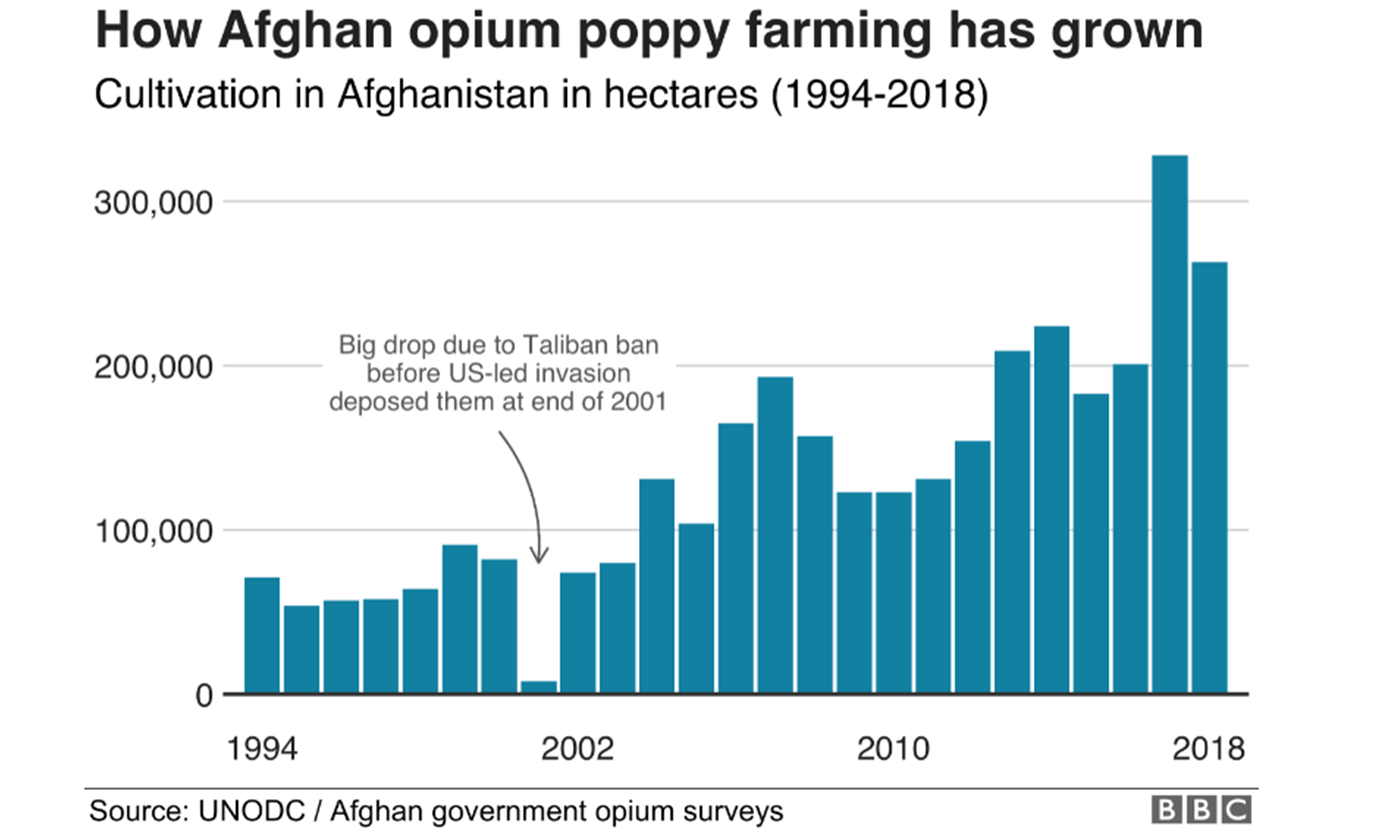
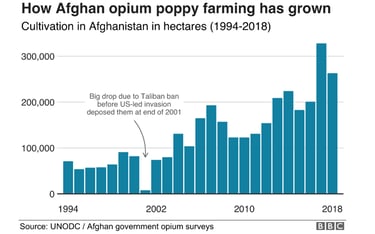
In 2013-2014 and 2016-2018, Afghanistan Poppy cultivation hit surpassed the previous high of 2007. This was reported by the BBC, citing the United Nations Office on Drugs and Crime (UNODC), as shown in the image below.
Sources:
ABC News, 4/2010, “Cash Crop” (Nick Schifrin reporting from Kandahar, Afghanistan)
ABC News, 9/21/2006, “‘We’re Losing Ground in Afghanistan’ says Top NATO Commander”
ABC News, 12/2/2009, “President Obama's Secret: Only 100 al Qaeda Now in Afghanistan”
ABC News, 8/8/2019, “From Intel Analyst to a Military ‘Uber’: Inside Mayor Pete Buttigieg’s Afghanistan Deployment”
Associated Press, 3/27/2003, “Afghanistan’s Farmers Growing More Opium”
Associated Press, 9/3/2006, “Afghanistan Opium Cultivation Skyrockets”
BBC, 4/25/2019, “How the US Military’s Opium War in Afghanistan Was Lost”
Fox and Friends, 4/2010, “Fighting the Opium Trade” (Geraldo Rivera reporting from the Helmand Province, Afghanistan)
Guardian, 8/11/2002, “Afghan Drug Lords Set up Drug Labs”
Independent, 8/14/2004, “US Soldiers Fear Afghan Drug War as Opium Profits Find Their Way to Al Qaeda”
Nation, 5/22/2001, “Bush’s Faustian Deal with the Taliban”
New York Times, 5/20/2001, “Taliban's Ban On Poppy A Success, U.S. Aides Say”
New York Times, 4/1/2002, “US Fears Afghan Farmers Can’t End Cash Crop” (also named: “U.S. Fears a Glut of Heroin From a Volatile Afghanistan”)
New York Times, 5/22/2005, “US Memo Faults Afghan Leader on Heroin Fight”
New York Times, 9/2/2006, “Opium Harvest at Record Level in Afghanistan”
New York Times, 9/22/2006, “NATO Chief Says More Troops Are Needed in Afghanistan”
New York Times, 10/4/2008, “Reports Link Karzai’s Brother to Afghanistan Heroin Trade”
New York Times, 10/27/2009, “Brother of Afghan Leader Said to Be Paid by C.I.A.”
Terrell Arnold, 7/3/2001, “It is Vital to Move Beyond 911”
USA Today, 12/23/2019, “Exclusive: With 218 Foreign Policy Endorsements, Buttigieg Targets a Big Biden Asset”