CHAPTER 18 - THE PENTAGON CRASH SITE
Summary
(1) Flight 77 took off from Dulles near Washington D.C. at 8:20. Shortly before 9 AM, it was hijacked, its transponder turned off, and it did a U-turn (Com-pg. 9, NYT) inside a small, anomalous gap in the U.S. primary radar system, causing FAA flight controllers to lose track of it. Officials mysteriously acknowledged the hijackers might have known about the radar gap (WAPO (11/3/2001)).
(2) Flight 77 hijacker pilot Hani Hanjour was so incompetent that he could not adequately fly a single-engine Cessna a month before 9/11 (WAPO (9/10/2002), Newsday). A Pan-Am flight school marveled that he had a commercial pilot’s license and brought him to the attention of the FAA five times a few months prior, but the FAA took no action (ABC (5/10/2002), CBS (5/10/2002), NYT). The FAA later refused to say where or how he obtained his license (WAPO (10/15/2001)). Despite his abject incompetence, Hanjour inexplicably performed a stunning aviation maneuver on 9/11 (CBS (9/11/2001), WAPO (9/10/2002, 9/12/2001)) that caused flight controllers to think they were observing a military jet (ABC (10/24/2001)).
(3) The Consensus 9/11 Panel (PR Newswire, MarketWatch) and a few media outlets (Time, Daily Mail, London Times) skeptically questioned how Hanjour could have performed this maneuver.
(4) The plane coincidentally struck the Pentagon Budget Office, destroying evidence and auditors (Arlington County After-Action Report, Mount Vernon Gazette) trying to reconcile $2.3 trillion in untraceable Defense Department transactions announced by Donald Rumsfeld the previous day (CBS).
(5) Over the next 14 years, that number grew to at least $21 trillion (NYT, Nation, Forbes). When Congress ordered an audit of the Pentagon in 2018 (which it was legally required to do annually, but never did) it failed miserably when third-party corporate accounting firms found so many errors that completing the audit was impossible. The auditors further found that the Pentagon annually committed massive fraud by making up numbers (Nation). Less than one year later, the Federal Accounting Standards Advisory Board (FASAB) quietly changed federal agency accounting rules in the name of national security so that any of the over 150 federal agencies could classify all of its expenditures and show the public completely different expenditures (FASAB, Rolling Stone).
(6) Extensive evidence indicated an explosion occurred at the Pentagon at 9:31 or 9:32 in the same location as the official 9:37 Flight 77 impact site. Evidence included eyewitness testimony from Secret Military Specialist April Gallop (WAPO, Reuters, PR Newswire), multiple stopped Pentagon clocks, eyewitness Denmark Foreign Minister Per Stig Moller, eyewitness Secretary of Defense for Special Operations Robert Andrews, White House Counsel/Attorney General Alberto Gonzales, one official FAA chronology document (Honegger), and numerous Pentagon employees who distinctly smelled the explosive cordite fumes instead of jet fuel (Time, Honegger). April Gallop attempted to sue Bush administration officials, but the suit was dismissed by a three-judge panel that included President Bush’s first cousin (PR Newswire).
(7) The Pentagon withheld from the public all footage from security cameras mounted to its primary structure (DOD x2, San Francisco Chronicle). A number of cameras that would normally have captured the Flight 77 impact were purportedly either being changed out during the attack or “down” to due construction or renovation projects (DOD, Washington Times). In response to a FOIA request, the FBI eventually publicized 5 frames from a low-quality security camera mounted to a nearby kiosk which showed an unidentifiable white blur followed by an explosion (CBS, Fox, PR Newswire).
(8) Some media outlets and government officials (including Honegger and CIA Department Director Bill Christison argued that the debris, damage, and size of the hole in the Pentagon were inconsistent with a Boeing 757 (WAPO, Time, Daily Mail, Honegger, Christison). Honegger alleged that the wreckage at the Pentagon crash site was from a remote-controlled U.S. Air Force A−3 Sky Warrior drone that targeted the auditors of the missing $2.3 trillion. She also asserted that the radar blip which flight controllers thought was a military jet was precisely that (Honegger).
(9) Dozens of eyewitnesses interviewed by mainstream media outlets saw an aircraft strike the Pentagon, with about a dozen of them specifying that they saw an American Airlines logo. Half a dozen described the size as being potentially consistent with a Boeing 757 (which Flight 77 was), while another five described the size as being significantly smaller and potentially consistent with a Boeing 737 and/or an A3 Sky Warrior (Albuquerque Tribune, CBS, CNN, Fox, Guardian, WAPO, etc.).
(10) The Flight 77 Cockpit Voice Recorder (CVR; ie. “Black Box”) data was deemed unrecoverable despite its remarkably robust design for plane crash survival (NTSB, NPR). The Flight Data Recorder (FDR; also part of the “Black Box”) data was recoverable. However, when it was released (via FOIA request) and analyzed by over a dozen experienced commercial/military pilots in the “Pilots for 9/11 Truth” organization, the data contradicted the official flight path narrative in terms of both direction and altitude (PR Newswire).
(11) The military secretly incinerated flight remains from the Pentagon impact site, leaving no physical evidence that it was hit by Flight 77 (WAPO, BBC, Daily Mail). The government also refused to publicly release an inventory of plane wreckage/debris collected (PR Newswire) and Senator Bob Graham, who co-chaired the 2002 Congressional Inquiry into 9/11, acknowledged there was a collaborative effort by federal agencies to keep information out of the public’s hands (BBC).
(12) The FBI briefly released 27 crash site photos to the public after ten years, immediately withdrew them again before the military’s secret evidence incineration was reported, then released them again after another six years (ABC, Time, Politico).
(13) Some observers theorized that aspects of 9/11 paralleled Operation Northwoods from the early 1960s in which the U.S. Joint Chiefs of Staff proposed staging commercial airliner hijackings, the destruction of a commercial airliner, and/or bombs detonated in U.S. cities to galvanize support for an invasion of Cuba (Joint Chiefs of Staff, San Francisco Chronicle, Daily Mail).
(1) Sources:
New York Times, 10/16/2001, “Transcript of American Airlines Flight 77”
Washington Post, 11/3/2001, “Pentagon Crash Highlights a Radar Gap”
9/11 Commission, July 2004, “9/11 Commission Report,” pg. 9
(2) Sources:
ABC News, 10/24/2001, “‘Get These Planes on the Ground’: Air Traffic Controllers Recall Sept. 11”
ABC News, 5/10/2002, “FAA Received Alert About 9/11 Hijacker”
CBS News, 9/11/2001, “Primary Target”
CBS News, 5/10/2002, “FAA Was Alerted To Sept. 11 Hijacker”
New York Times, 6/19/2002, “TRACES OF TERROR: THE F.B.I.; For Agent in Phoenix, the Cause of Many Frustrations Extended to His Own Office”
Newsday, 9/23/2001, “Tracing the Trail of Hijackers”
Washington Post, 9/10/2002, “Mysterious Trip to Flight 77 Cockpit”
Washington Post, 9/12/2001, “On Flight 77: ‘Our Plane Is Being Hijacked’”
Washington Post, 10/15/2001, “Hanjour a Study in Paradox”
(3) Sources:
Daily Mail, 8/6/2005, “9/11 on Trial”
Daily Mail, 2/9/2007, “An Explosion of Disbelief”
MarketWatch, 5/6/2011, “The 9/11 Hijackers: Fraud in Official Video Exhibits Uncovered by Expert Panel”
PR Newswire, 9/9/2011, “New Investigative Panel Releases 13 Consensus Statements of Evidence Opposing the Official Account of 9/11”
PR Newswire, 5/6/2011, “Obama Says ‘Justice Has Been Done’: Bin Laden Scholar Says No”
Sunday Times, 9/4/2005, “9/11 Revealed: Challenging the Facts behind the War on Terror”
Time Magazine, 9/3/2006, “Why The 9/11 Conspiracies Won’t Go Away”
(4) Sources:
Arlington County, 2002, “Arlington County After-Action Report on the Response to the September 11 Terrorist Attack on the Pentagon,” page A-86
CBS, 1/29/2002, “The War on Waste”
Mount Vernon Gazette, 9/4/2002, “An Engineer’s Expertise Joins A Firefighter’s Nightmare”
(5) Sources:
Federal Accounting Standards Advisory Board, 10/4/2018, “News Release: FASAB Issues Statement of Federal Financial Accounting Standards 56, Classified Activities”
Forbes, 12/8/2017, 12/8/2017, “Has Our Government Spent $21 Trillion Of Our Money Without Telling Us?”
Forbes, 7/21/2018, “Is Our Government Intentionally Hiding $21 Trillion In Spending?”
New York Times, 12/3/2018, “The Misleading Claim That $21 Trillion in Misspent Pentagon Funds Could Pay for ‘Medicare for All’”
Rolling Stone, 1/16/2019, “Has the Government Legalized Secret Defense Spending?”
The Nation, 11/27/2018, “Exclusive: The Pentagon’s Massive Accounting Fraud Exposed: How US Military Spending Keeps Rising Even as the Pentagon Flunks its Audit.”
(6) Sources:
Barbara Honegger, 9/6/2006, “THE PENTAGON ATTACK PAPERS; Seven Hours in September: The Clock that Broke the Lie”
PR Newswire, 3/23/2011, “Amidst Growing World Doubts About 9/11, Career Army Officer Takes Bush Administration Officials to Court April 5th Represented by the Center for 9/11 Justice”
PR Newswire, 4/7/2011, “Extraordinary Conflict of Interest: Bush Cousin Presides Over Federal Court Case Against Former Bush Administration Officials”
Reuters, 2/2/2012, “Court Sanctions Lawyers Behind September 11 Conspiracy Case”
Time Magazine, 9/3/2006, “Why The 9/11 Conspiracies Won’t Go Away”
Washington Post, 9/9/2011, “After 9/11, Woman Who Was at Pentagon Remains Skeptical”
(7) Sources:
CBS News, 5/16/2006, “Pentagon Makes Public 9/11 Footage”
Department of Defense, 11/9/2006, “Oral History Interview with Brian Austin and Steve Pennington by Diane Putney”
Department of Defense, 2007 (completed; published 2013), “Pentagon 9/11”
Fox News, 5/16/2006, “Pentagon Releases Video of Plane Hitting Building on 9/11”
PR Newswire, 3/1/2006, “Experts Call for Release of 9/11 Evidence”
San Francisco Chronicle, 9/3/2006, “The Conspiracy to Rewrite 9/11”
Washington Times, 9/21/2001, “Inside the Ring”
(8) Sources:
Barbara Honegger, 9/6/2006, “THE PENTAGON ATTACK PAPERS; Seven Hours in September: The Clock that Broke the Lie”
Bill Christison, 8/14/2006, “Stop Belittling the Theories About September 11”
Daily Mail, 8/6/2005, “9/11 on Trial”
Time, 9/3/2006, “Why The 9/11 Conspiracies Won’t Go Away”
Washington Post, 10/7/2004, “Conspiracy Theories Flourish on the Internet”
(9) Sources:
Albuquerque Tribune/Scripps Howard News Service, 9/12/2001, “Mournful Church Bells Toll, Police Sirens Soar as D.C. Explodes Into Panic”
CBS, 9/13/2001, “The Early Show,” Interview of Colonel Mitch Mitchell
CNN, 9/11/2001, “America Under Attack: Israeli Prime Minister, Foreign Minister Offer Condolences to the American People,” Interview of Mike Walter of “USA Today Live”
Fox News/Associated Press, 9/11/2001, “Hijacked Planes Used in Coordinated Attacks Upon New York, Washington”
Guardian, 9/12/2001, “‘Everyone Was Screaming, Crying, Running. It’s Like a War Zone’”
Washington Post, 9/11/2001, “‘Extensive Casualties’ in Wake of Pentagon Attack”
Washington Post (online video), 9/11/2001, “Eyewitness to Pentagon Attack: Washington area residents Allen Cleveland and Meseidy Rodriguez were riding the metro and saw the plane that apparently crashed into the Pentagon.”
Washington Post, 9/12/2001, “Loud Boom, Then Flames In Hallways”
Washington Post, 9/20/2001, “‘The Terrorists Cannot Kill Our Spirit’”
(10) Sources:
National Transportation Safety Board, 4/30/2002, “Specialist’s Factual Report of Investigation: [Flight 77] Cockpit Voice Recorder”
NPR, 3/11/2014, “What Would It Take To Destroy A Black Box?”
PR Newswire, 6/21/2007, “New Study from Pilots for 9/11 Truth: No Boeing 757 Hit the Pentagon”
(11) Sources:
BBC News, 2/14/2007, “9/11 questions”
Daily Mail, 2/9/2007, “An Explosion of Disbelief”
PR Newswire, 3/1/2006, “Experts Call for Release of 9/11 Evidence”
Washington Post, 2/28/2012, “Portions of 9/11 Victims’ Remains Taken to Landfill, Report Says”
(12) Sources:
ABC News, 3/31/2017, “FBI Re-Releases 9/11 Pentagon Photos”
Time, 3/31/2017, “FBI Releases Never-Before-Seen Photos From 9/11 Pentagon Attack”
Politico, 3/31/2017, “FBI Releases Never-Before-Seen Photos From 9/11 Pentagon Attack”
(13) Sources:
Daily Mail, 8/6/2005, “9/11 on Trial”
San Francisco Chronicle, 9/3/2006, “The Conspiracy to Rewrite 9/11”
The Joint Chiefs of Staff, 3/13/1962, “Memorandum for the Secretary of Defense; Subject: Justification for US Military Intervention in Cuba,” A.K.A “Northwoods”
Flight 77 Disappears In a Primary Radar Gap
Flight 77 took off from Dulles International Airport near Washington D.C. at 8:20. Its last routine radio communication was at 8:51 A.M. Shortly thereafter, the hijackers took control of the plane. It began to deviate from its flight plan at 8:54. At 8:56, the transponder was turned off and the plane turned around and headed back toward Washington D.C.
According to government officials interviewed by the Washington Post, the hijackers turned off the transponder within a small gap in the FAA’s primary radar coverage over the United States, which made their turn back toward Washington D.C. invisible to Indianapolis flight control as it monitored the flight. Officials told the Washington Post that timing of the transponder being turned off was “likely just a coincidence,” but added the caveat:
“…there is a remote possibility that the hijackers knew where to turn off the transponder.”
This statement begged the question: How could the hijackers have known about the radar gap?
Sources:
New York Times, 10/16/2001, “Transcript of American Airlines Flight 77”
Washington Post, 11/3/2001, “Pentagon Crash Highlights a Radar Gap”
9/11 Commission, July 2004, “9/11 Commission Report,” pg. 9
An Incompetent Hijacker Pilot Pulls off an Astounding Aviation Feat
Hani Hanjour was the hijacker pilot of Flight 77, which hit the Pentagon. According to the Washington Post (10/15/2001), records of his flight training began in 1996 when he trained for three months at Cockpit Resource Management (CRM) in Scottsdale, Arizona. However, Hanjour was such a weak student that CRM’s owner Duncan Hastie discontinued his training. Hastie later said, Hanjour “was wasting our resources.” Hanjour tried to return about twice per year for the next three years, stating that he wanted to be an airline pilot. However, Hastie refused to accept him and thought to himself:
“[He’s] never going to make it.”
In 1998, Hanjour went to Sawyer Aviation in Phoenix to use their flight simulator for a handful of lessons. The flight simulator manager there later said:
“[He was] a neophyte… he came and, like a lot of guys, got overwhelmed with the instruments.”
Despite Hanjour’s complete lack of competence up to this point, FAA records show he somehow obtained a commercial pilot's license in April of 1999. After the 9/11 attacks, FAA officials refused to discuss how or where he obtained it, according to the Washington Post (10/15/2001).
In February of 2001, per the New York Times, Hanjour enrolled at a Pan Am-owned Phoenix flight school for commercial airliner training in an advanced simulator. However, he was such an awful pilot that instructors contacted the FAA to find out if his license was fake. CBS News (5/10/2002) clarified that the school’s managers actually reported Hanjour to the FAA “at least five times… because his English and flying skills were so bad.” (Demonstrated English proficiency was a requirement for obtaining a commercial pilot’s license.) ABC News (5/10/2002) reported that FAA inspector John Anthony confirmed to the school that Hanjour’s license was valid and even sat in the same classroom with Hanjour for one course at the school, but then took no further action. The FAA would not permit Anthony to be interviewed.
In August of 2001, according to the Washington Post (9/10/2002), one month before the 9/11 attacks, Hanjour went to the Freeway Airport in Bowie, Maryland. Per Newsday, he showed the instructors there his federal pilot’s license and logbook cataloging 600 hours of flying experience. However, after taking three lessons on a single-engine Cessna 172 and having trouble controlling the plane, the flight instructors decided he was not yet ready to fly the plane by himself. They declined to rent him one.
Despite such an abysmal track record, on the morning of 9/11, Flight 77 executed a stunning tight 270-degree turn while simultaneously steeply descending 7,000 feet in two and half minutes to exactly ground level just as it impacted the Pentagon, per CBS (9/11/2001) and Washington Post (9/12/2001). The maneuver amazed experts. On the day of the attacks, CBS News stated:
“Radar shows Flight 77 did a downward spiral, turning almost a complete circle and dropping the last 7,000 feet in two-and-a-half minutes… the complex maneuver suggests the hijackers had better flying skills than many investigators first believed. The jetliner disappeared from radar at 9:37 and less than a minute later it clipped the tops of street lights and plowed into the Pentagon at 460 mph.”
The next day, the Washington Post (9/12/2001) stated:
“[The] pilot executed a pivot so tight that it reminded observers of a fighter jet maneuver. The plane circled 270 degrees to the right to approach the Pentagon from the west, whereupon Flight 77 fell below radar level, vanishing from controllers’ screens… Aviation sources said the plane was flown with extraordinary skill, making it highly likely that a trained pilot was at the helm…”
One year later, the Washington Post again stated:
“…aviation experts concluded that the final maneuvers of American Airlines Flight 77 – a tight turn followed by a steep, accurate descent into the Pentagon -- was the work of ‘a great talent’… but months before the attacks… [Hanjour’s] instructors became so alarmed by his crude skills and limited English they notified the FAA to determine whether his pilot’s license was real.”
Dulles Air traffic controller Danielle O'Brien, who watched the turn unfold in real-time on radar, told ABC News (10/24/2001):
“The speed, the maneuverability, the way that he turned, we all thought in the radar room, all of us experienced air traffic controllers, that that was a military plane.”
Oddly, the 9/11 Commission Report stated that Hanjour was chosen for the task of piloting Flight 77 because he was “the operation’s most experienced pilot.” It mentioned neither his inability to safely handle a one-engine Cessna one month prior, nor the irreconcilability of this fact with the maneuver he executed.
Sources:
ABC News, 10/24/2001, “‘Get These Planes on the Ground’: Air Traffic Controllers Recall Sept. 11”
ABC News, 5/10/2002, “FAA Received Alert About 9/11 Hijacker”
CBS News, 9/11/2001, “Primary Target”
CBS News, 5/10/2002, “FAA Was Alerted To Sept. 11 Hijacker”
New York Times, 6/19/2002, “TRACES OF TERROR: THE F.B.I.; For Agent in Phoenix, the Cause of Many Frustrations Extended to His Own Office”
Newsday, 9/23/2001, “Tracing the Trail of Hijackers”
Washington Post, 9/10/2002, “Mysterious Trip to Flight 77 Cockpit”
Washington Post, 9/12/2001, “On Flight 77: ‘Our Plane Is Being Hijacked’”
Washington Post, 10/15/2001, “Hanjour a Study in Paradox”
9/11 Commission, July 2004, “9/11 Commission Report,” Ch. 7 Footnote 147, pg. 530
Allegations that Hani Hanjour Could Not Have Flown in Such a Manner
Some media outlets were deeply skeptical about how Flight 77 could have been piloted by such an incompetent pilot as Hani Hanjour. Here are several examples. In August of 2005, the Daily Mail stated:
“Still more unanswered questions surround what happened at the Pentagon in Washington, in the third successful terrorist attack that day… Experienced officials apparently watched its speed and maneuverability and thought it must be a military plane.”
“The plane that hit the Pentagon was seen to swerve at the last minute and hit an area of the building that was largely unoccupied – and which had just been fitted with reinforced external walls and blast-resistant windows. A crash into the other side would have killed and maimed many thousands instead of just 125.”
In September of 2005, the Sunday Times of London stated:
“…the route taken by Hanjour… required a complex maneuver by an experienced pilot. Yet in 2001, when Hanjour tried to fly down the Hudson air corridor in a light aircraft, his trainer was so unnerved that he denied him a second run. You don’t have to be a conspiracy nut to see that the official account published by the 9/11 Commission is full of gaps.”
In September of 2006, Time Magazine stated:
“…could Hani Hanjour, the man supposedly at the controls, have executed the maneuvers that the plane performed? He failed a flight test just weeks before the attack.”
In February of 2009, the Daily Mail questioned:
“How could a rookie pilot… fly a Boeing 757 aircraft so precisely into the Pentagon?”
In May of 2011, PR Newswire stated:
“The Washington Post reported that the plane hitting the Pentagon was maneuvered ‘with extraordinary skill,’ but the New York Times called the alleged pilot, Hani Hanjour, ‘A Trainee Noted for Incompetence.’”
In September of 2011, PR Newswire stated the following regarding the 9/11 Consensus Panel organization:
“For ten years independent scholars and researchers have been investigating the troubling anomalies of the 9/11 official account… [such as] the airliner strike on the Pentagon by incompetent al-Qaeda pilot Hani Hanjour.”
In September of 2012, Wall Street Journal’s MarketWatch stated the following regarding the 9/11 Consensus Panel:
“A Panel of 22 researchers into the history of 9/11… has produced 28 Consensus Points of ‘best evidence’ regarding the official claims of 9/11… [including] the inadequate flying skills of the alleged Pentagon pilot…”
Sources:
Daily Mail, 8/6/2005, “9/11 on Trial”
Daily Mail, 2/9/2007, “An Explosion of Disbelief”
MarketWatch, 5/6/2011, “The 9/11 Hijackers: Fraud in Official Video Exhibits Uncovered by Expert Panel”
PR Newswire, 9/9/2011, “New Investigative Panel Releases 13 Consensus Statements of Evidence Opposing the Official Account of 9/11”
PR Newswire, 5/6/2011, “Obama Says ‘Justice Has Been Done’: Bin Laden Scholar Says No”
Sunday Times, 9/4/2005, “9/11 Revealed: Challenging the Facts behind the War on Terror”
Time Magazine, 9/3/2006, “Why The 9/11 Conspiracies Won’t Go Away”
Budget Office Struck; Untraceable Transactions Grow from $2.3 to $21 Trillion
Perhaps equally astounding to Hanjour’s maneuver was the coincidence of where the plane impacted – the budget office where analysts were trying to reconcile $2.3 trillion in untraceable transactions Defense Secretary Donald Rumsfeld announced the previous day, stating:
“The adversary is… the Pentagon bureaucracy… According to some estimates we cannot track $2.3 trillion in transactions.”
That Flight 77 hits the Pentagon budget office was confirmed by multiple sources. For example, a post-9/11 Arlington County After-Action Report stated:
“It was also the end of the fiscal year and important budget information was in the damaged area.”
Similarly, the Mount Vernon Gazette reported:
“The plane had gone in right where [a victim] was located as part of the budget analyst office.”
While the unaccounted-for $2.3 trillion might have grown into a major scandal, such budget concerns fell by the wayside in the wake of 9/11. Instead, the problem grew much worse. According to Forbes, Nation, and the New York Times, a minimum of $21 trillion of Pentagon financial transactions between 1998 and 2015 could not be “traced, documented, or explained”. The Nation and New York Times both pointed out that the untraceable transactions resulted in adjustments to “both the positive and the negative sides of the ledger, thus potentially netting each other out.” Therefore, the core issue was the utter void of transparency/accountability rather than any firm grasp of exactly how much money was spent on secretive and/or fraudulent transactions.
Throughout that period, the Defense Department neglected to perform a single required annual audit for decades, congress finally ordered an independent audit in 2018. According to Nation, the Defense Department failed the audit after multiple third-party corporate accounting firms concluded that its financial records contained so many errors that completing the audit was impossible. The audit further showed that the Defense Department had perpetrated “massive fraud” by making up numbers for decades in its annual financial reports to congress.
Sources:
Arlington County, 2002, “Arlington County After-Action Report on the Response to the September 11 Terrorist Attack on the Pentagon,” page A-86
CBS, 1/29/2002, “The War on Waste”
Forbes, 12/8/2017, 12/8/2017, “Has Our Government Spent $21 Trillion Of Our Money Without Telling Us?”
Forbes, 7/21/2018, “Is Our Government Intentionally Hiding $21 Trillion In Spending?”
Mount Vernon Gazette, 9/4/2002, “An Engineer’s Expertise Joins A Firefighter’s Nightmare”
New York Times, 12/3/2018, “The Misleading Claim That $21 Trillion in Misspent Pentagon Funds Could Pay for ‘Medicare for All’”
The Nation, 11/27/2018, “Exclusive: The Pentagon’s Massive Accounting Fraud Exposed: How US Military Spending Keeps Rising Even as the Pentagon Flunks its Audit.”
154 Government Agencies Quietly Empowered to Hide True Financials from the Public
This brief section is a worthwhile tangent, after which we will return to the topic of Flight 77 and the Pentagon impact. Less than a year after the Defense Department failed its 2018 audit and could not account for $21 trillion of expenditures, the state of federal financial transparency and oversight went from horrible to even more horrible. On October 4th, 2018, the Federal Accounting Standards Advisory Board (FASAB) quietly issued a news release concerning a new federal accounting standard entitled, “Statement of Federal Financial Accounting Standards 56, Classified Activities” or SFFAS 56. The news release stated:
“SFFAS 56 balances the need for financial reports to be publicly available with the need to prevent the disclosure of classified national security information or activities… The statement permits
1) an entity to modify information… if the effect of the modification does not change the net results of operations or [financial] position.
2) [an] entity [may be] consolidated into another… entity, and the effect of the modifications may change the net results of operations and/or [financial] position.”
3) an entity may… allow other modifications to information… and the effect of the modifications may change the net results of operations and/or [financial] position.”
On the day of the release, the news cycle was dominated by partisan fighting over Brett Kavanaugh’s nomination to the Supreme Court. Not a single media outlet covered the FASAB news release, nor did any media outlet report on it in the years that followed other than a single January of 2019 article by Rolling Stone magazine. The article was discomforting. It pointed out that the Treasury Department’s definition of an “entity” as it was used in the news release:
“…includes 154 different agencies and bodies, from the Smithsonian Foundation to the CIA to the SEC to the Farm Credit Administration to the Railroad Retirement Board.”
Therefore, each of these 154 agencies could now legally alter its public financial report in the name of “national security.” Furthermore, per Rolling Stone, the new standard “expressly allows federal agencies to refrain from telling taxpayers if and when public financial statements have been altered.” The article quoted Michigan State professor Mark Skidmore, a perennial researcher of defense expenditure discrepancies, as stating:
“The list of agencies is so long. If you don’t even know what’s been modified, why bother reading a summary for any of them?”
The press release included the name and contact information of FASAB’s assistant director Monica Valentine for questions. When Rolling Stone asked why this accounting standard did not apply only to agencies with a national security mandate, Valentine replied:
“We use a standard scope paragraph in all of our standards… It is simply more practical to make the standards broadly applicable.”
Rolling Stone pointed out that the second and third points in the news release directly contradict the first point. The first says “the modification” cannot “change the net results” of the agency’s overall financial pictures or operations. However, the third says precisely the opposite – that “other modifications… may change the net results” of the agency’s overall financial picture or operations. There is no verbiage to explain the difference between “modification” in point one and “other modifications” in point two. When Rolling Stone asked Valentine whether this essentially allows for unlimited secret changes to the finances or operations of any government agency, she responded:
“We cannot speculate about the changes.”
When Rolling Stone asked Monica Valentine if a Department of Defense expenditure could hypothetically be moved to the Department of Housing and Urban Development, she replied:
“Because of the classified nature of this topic, I will not respond to specific examples.”
The new standard effectively meant two sets of government accounting books. Michigan State professor Mark Skidmore stated:
“From this point forward the federal government will keep two sets of books, one modified book for the public and one true book that is hidden.”
Similarly, Catherine Austin Fitts, Assistant Secretary for Housing and Urban Development under George H.W. Bush administration said the new standard “expressly approved[s] obfuscation of reporting and, in some cases, outright concealing financials.”
Likewise, The Department of Defense Inspector General stated:
“This approach would likely make the financial statements misleading to all but a select few individuals that are aware of the Interpretation.”
Also, FASAB consultant and private financial firm Kearney & Co. said the standard would allow “only select individuals to view and accept” the modifications. Rolling Stone summarized:
“…the new guidance…[creates] essentially a two-book system. Public statements would at best be unreliable, while the real books would be audited in ‘classified environment[s]’ by certain designated officials.”
When Rolling Stone asked FASAB who had authority to make the secret modifications, Valentine replied:
“Please contact the federal entity’s Office of the Inspector General for questions pertaining to who does the auditing in a classified environment.”
By way of background, the article noted that the idea of secret budgets in American began in 1949, via the Central Intelligence Agency Act, which shielded the agency from public financial disclosure, stating:
“No Money shall be drawn from the Treasury… The sums made available to the Agency may be expended without regard to the provisions of law… [Furthermore,] expenditures [are] to be accounted for solely on the certificate of the Director…”
In the mid-1970s, the Supreme Court by a 5-4 vote upheld the federal government’s power to employ secret budgets. In 1999, the rationale for secret budgets was verbalized by CIA Director George Tenet in this way:
“Disclosure of the budget request reasonably could be expected to provide foreign governments with the United States’ own assessment of its intelligence capabilities and weaknesses.”
However, a few years before this statement, the Brown-Aspin Commission, which Congress formed to examine intelligence-related issues, determined precisely the opposite – that publishing “bulk amounts of national security expenditures” did not pose any risk to national security. Three former CIA directors agreed with this assessment.
Sources:
Federal Accounting Standards Advisory Board, 10/4/2018, “News Release: FASAB Issues Statement of Federal Financial Accounting Standards 56, Classified Activities”
Rolling Stone, 1/16/2019, “Has the Government Legalized Secret Defense Spending?”
Lawsuit Alleges 9:31 Pentagon Bomb Explosion; Bush’s Cousin and Two Other Judges Dismiss
According to PR NewsWire, Top Secret Military Specialist April Gallop was working in the Pentagon when an explosion stopped her watch and other clocks nearby at 9:31. Gallop subsequently escaped to the outside of the building through the hole created by this explosion – the same hole that officially was caused by Flight 77’s impact at 9:37. As she escaped, Gallop saw no signs of an aircraft, such as seats, luggage, metal, or human remains. The Washington Post stated:
“‘Where was the plane?’ The scene… [contained] no aircraft wreckage; smoke and flames, but no jet-fuel inferno. ‘I was 50 feet from the impact zone,’ Gallop says. ‘The engine should have been in my lap.’”
Gallop was not the only person to make assertions of this nature. Barbara Honegger was a Senior Military Affairs Journalist at the Naval Postgraduate School, a White House Policy Analyst under President Ronald Reagan, and author of the famous 1989 political exposé, October Surprise. In 2006, she published an essay entitled, “The Pentagon Attack Papers,” in which she listed numerous points in support of the notion that a bomb exploded in the Pentagon between 9:31 and 9:32 apart from, and possibly in addition to, an aircraft impacting the same location at 9:37. Her points included:
Multiple standard-issue military clocks near the impact zone stopped between 9:31 and 9:32, including one that was put on display at the Smithsonian Institution.
Denmark Foreign Minister Per Stig Moller was in Washington, D.C. building on 9/11 with a view of the Pentagon. According to Denmark radio interviews he gave the next day, Moller heard an explosion, looked out the window and the smoke rising from the Pentagon, then looked at his watch, which read 9:32
On August 27, 2002, then-White House Counsel and future Attorney General Alberto Gonzales gave a lecture at the Naval Postgraduate School in which he explicitly stated: “The Pentagon was attacked at 9:32.”
Four Pentagon employees, including Gallop, witnessed multiple teams of bomb-sniffing dogs and their K-9 handlers in camouflage uniform outside the Pentagon at approximately 7:30 am on 9/11. One of the witnesses, an Army auditor, said this never occurred before or since 9/11.
Honegger personally interviewed former Green Beret and then-Acting Assistant Secretary of Defense for Special Operations, Robert Andrews. He told Honegger that around 9:32, the room he was in near the impact zone was shaken violently, ceiling tiles fell, and smoke filled the room.
The FAA’s timeline document, “Executive Summary—Chronology of a Multiple Hijacking Crisis––September 11, 2001” lists “0932” as the time at which air traffic controllers reported that an aircraft had impacted the Pentagon.
Multiple individuals at the Pentagon said they smelled cordite after the explosion. Cordite is an explosive with a distinct smell that is very different from that of burning jet fuel.
This last point was also highlighted by Time Magazine, which stated:
“…Pentagon employees reported smelling cordite after the hit, the kind of high explosive a cruise missile carries.”
Honegger also quoted Gallop as stating:
“Being in the Army with the training I had, I know what a bomb sounds and acts like, especially the aftermath, and it sounded and acted like a bomb.”
Honegger ultimately laid the accusation:
“As no ‘outside’ terrorist, al Qaeda or otherwise, could have had access to… the Pentagon… only domestic insiders could have pre-placed the explosives in… the Pentagon…”
“The US military, not al Qaeda, had the access to plant explosives inside its own most heavily defended world headquarters, the Pentagon…”
After 9/11, per PR Newswire (3/23/2011) officials told Gallop not to share her experiences in public. She was also emailed by a Fox News reporter who had been warned by the Pentagon not to interview her.
However, in 2008, Gallop filed a lawsuit in federal court against Vice President Dick Cheney, Secretary of Defense Donald Rumsfeld, and Chairman of the Joint Chiefs of Staff, Richard Myers. According to PR Newswire, Reuters, and the Washington Post, the lawsuit alleged that the defendants were willfully complicit in the 9/11 attacks and saw them as a way to expand U.S. hegemony into the Middle East.
In 2011, five days before opening arguments, one of Gallop’s three attorneys, William Veale, learned that former President George W. Bush’s first cousin, Judge John Walker, had been assigned to the case along with two other judges. Veale filed a motion to disqualify Judge Walker, but the motion was denied.
Per PR Newswire, Gallop’s case relied on “photographic and other physical evidence, as well as the testimony of a multitude of military and civilian survivors.” However, in 2012, the court dismissed the lawsuit as frivolous and ordered two of Gallop’s attorneys to pay $15,000 in sanctions to compensate the government for having defended the case.
Sources:
Barbara Honegger, 9/6/2006, “THE PENTAGON ATTACK PAPERS; Seven Hours in September: The Clock that Broke the Lie”
PR Newswire, 3/23/2011, “Amidst Growing World Doubts About 9/11, Career Army Officer Takes Bush Administration Officials to Court April 5th Represented by the Center for 9/11 Justice”
PR Newswire, 4/7/2011, “Extraordinary Conflict of Interest: Bush Cousin Presides Over Federal Court Case Against Former Bush Administration Officials”
Reuters, 2/2/2012, “Court Sanctions Lawyers Behind September 11 Conspiracy Case”
Time Magazine, 9/3/2006, “Why The 9/11 Conspiracies Won’t Go Away”
Washington Post, 9/9/2011, “After 9/11, Woman Who Was at Pentagon Remains Skeptical”
DOD Withholds Footage from Pentagon-Mounted Security Cameras; Produces No Video Evidence of Flight 77 Impact; Some Key Cameras Are Non-Operational or Being Switched Out
In August of 2005, the Daily Mail pointed out that security camera footage from the Doubletree Hotel and Citgo gas station near the Pentagon was seized “within minutes” of the Pentagon impact.
In September of 2005, in response to a Freedom of Information Act lawsuit brought against the FBI and Department of Justice, FBI Counterterrorism Special Agent Jacqueline Maguire submitted a declaration to the Washington D.C. District Court stating that she had thoroughly searched the FBI’s database of video footage that might have captured the Flight 77 impact. She initially identified 85 candidate videotapes, but dismissed 56 without viewing them based on documentation about them. Of the remaining 29 videotapes, she determined that only one of them showed the impact. The declaration stated:
“…I subsequently searched a series of FBI evidence databases… and determined that the FBI possessed eighty-five (85) videotapes that might be potentially responsive to plaintiff's FOIA… I next determined, through an examination of… written supporting documentation associated with each videotape, that fifty-six (56) of these videotapes did not show either the Pentagon building, the Pentagon crash site, or the impact of Flight 77 into the Pentagon on September 11, 2001.”
“I personally viewed the remaining twenty-nine (29) videotapes. I determined that sixteen (16) of these videotapes did not show the Pentagon crash site and did not show the impact of Flight 77 into the Pentagon on September 11, 2001. Out of the remaining thirteen (13) videotapes, which did show the Pentagon crash site, twelve (12) videotapes only showed the Pentagon after the impact of Flight 77. I determined that only one videotape showed the impact of Flight 77 into the Pentagon on September 11, 2001.”
The declaration listed the source of the 85 videos. The vast majority were from sources other than the Pentagon, such as a New Jersey residence, Kinko’s surveillance cameras, media photographers, numerous home videos, the Reagan National Airport parking garage, a Citgo gas station, and a Doubletree Hotel. Thirteen were provided by the Pentagon police, 6 of which were blank. Only a single videotape from a security camera mounted to a kiosk on the road into the Pentagon Mall purported to show the Flight 77 impact.
The omission of any footage from security cameras mounted to the exterior of the Pentagon’s primary structure was noticed by Robert Bowman, a former U.S. Air Force lieutenant colonel with a doctorate from the California Institute of Technology, who directed the “Star Wars” missile defense program under Presidents Gerald Ford and Jimmy Carter. Per the San Francisco Chronicle, he asked:
“…why the Pentagon didn't release surveillance tapes of American Airlines Flight 77 hitting the military complex.”
In March of 2006, according to PR Newswire, Judicial Watch and the 9/11 Consensus Panel (of which Robert Bowman was a part) called for the public release of the footage from all Pentagon surveillance tapes from the morning of 9/11, as well as footage from other private nearby security cameras that was seized by the FBI just after the Flight 77 impact. In May of 2006, per CBS News and Fox News, the Defense Department publicly released 5 frames from the aforementioned security camera mounted to the kiosk on the road to the Pentagon Mall. The frames show an unidentifiable “thin white blur” (CBS quote) followed by an explosion.
In December of 2006, the Defense Department released to CNN footage from the security camera outside the Arlington Doubletree Hotel which had been seized by the FBI. The footage showed an explosion, but no aircraft. No footage was ever released from security cameras mounted to the exterior of the Pentagon.
In 2007, the Defense Department completed the book, “Pentagon 9/11,” which was eventually published in 2013. The preface described the book this way:
“The OSD [Office of the Secretary of Defense] Historical Office initiated the project… more than 1,300 people… participated in oral history interviews… this account represents the most comprehensive effort to date to capture what occurred at the Pentagon on 9/11.”
Months earlier, one of the authors – Diane Putney – interviewed the Pentagon’s head security camera consultant, Steve Pennington, who told Putney that there were exterior cameras in the vicinity of the crash site just as Bowman asserted. Some were destroyed or lost connectivity during impact, but this didn’t matter since the footage itself was digitally stored in the Pentagon Communications Center. Nevertheless, Pennington claimed that none of these cameras captured anything useful. Regarding his role at the Pentagon, Pennington stated:
“I am one of the two partners that own Chesapeake [Marketing Associates, Inc.]. My capacity then [during 9/11] was… a consultant to… the Pentagon Force Protection people, mainly for security cameras…”
Regarding two particular cameras in the crash site vicinity, Pennington stated:
“There was a camera on the building pretty much at the point of impact which was destroyed immediately. It was viewing an exterior door. There was a camera on the Heliport that was destroyed right away as well. Those cameras weren’t able to give us any information; we looked and there was nothing there.”
Likewise, “Pentagon 9/11” stated on page 153:
“Some of the [Communications] center’s eight monitor screens mounted on a wall remained blank because the crash had destroyed the camera nearest to the impact site and cut connectivity to others.”
When Putney asked Pennington whether he had to physically “go to those cameras and get the component piece that might have taken the images,” Pennington replied:
“All the information was captured in the building.”
Finally, Pennington revealed that other cameras that typically would have captured the Flight 77 impact were either being changed out exactly when the impact occurred or were “down” due to construction or renovation projects. Pennington stated:
“There were cameras on poles at the other end along the roadway but they were down for construction projects or being changed out during the process. Other cameras would normally look at that area, but because that area was being renovated, a lot of the connectivity of those cameras and the infrastructure that allowed those cameras to be connected back to the building had been removed or destroyed so they weren't capturing images and offering fields of view.”
Similarly, the Washington Times reported:
“The Pentagon has told broadcast news reporters that its security cameras did not capture the crash. The attack occurred close to the Pentagon's heliport, an area that normally would be under 24-hour security surveillance, including video monitoring.”
Sources:
CBS News, 5/16/2006, “Pentagon Makes Public 9/11 Footage”
CNN, 12/2/2006, “Hotel Security Video Shows 9/11 Pentagon Blast, But No Plane”
Daily Mail, 8/6/2005, “9/11 on Trial”
Department of Defense, 11/9/2006, “Oral History Interview with Brian Austin and Steve Pennington by Diane Putney”
Department of Defense, 2007 (completed; published 2013), “Pentagon 9/11”
Fox News, 5/16/2006, “Pentagon Releases Video of Plane Hitting Building on 9/11”
Huffington Post, 12/4/2006, “FBI Releases Never-Before-Seen 9/11 Footage...”
PR Newswire, 3/1/2006, “Experts Call for Release of 9/11 Evidence”
San Francisco Chronicle, 9/3/2006, “The Conspiracy to Rewrite 9/11”
Unites States District Court, District of Columbia, Scott Bingham vs. United States Department of Justice and Federal Bureau of Investigation, Civil Action No. 1:05-00475 (PLF), 9/7/2005, “Declaration of Jacqueline Maguire” (FBI Special Agent, Counterterrorism Division, Washington Field Office)
Washington Times, 9/21/2001, “Inside the Ring”
Media Outlets and U.S. Officials Say Flight 77 Could Not Have Made the Hole in the Pentagon
In August of 2005, an article in the Daily Mail observed:
“Photographs show that the hole [Flight 77] made was large enough for the fuselage of a Boeing 757 but not for the wings and the tail, though these supposedly disappeared through the gap and then vaporized… Some witnesses claim the plane they say hit the Pentagon was a small one, an eight – or 12-seater, and that it did not have the roar of an airliner but the shrill whine of a fighter plane. One witness is convinced it was a missile.”
In October of 2004, the Washington Post stated:
“…photographs taken shortly after impact… seem incompatible with damage caused by a jumbo jet…”
“…a perfectly round hole in a Pentagon wall where the Boeing 757 punched through… is less than 20 feet in diameter.”
In August of 2006, the Seattle Post-Intelligencer reported that, according to a Scripps Howard/Ohio University poll, twelve percent of those polled suspected:
“…[the Pentagon] was struck by a military cruise missile in 2001 rather than by an airliner captured by terrorists.”
In August of 2006, Bill Christison, former Director of the CIA’s Office of Regional and Political Analysis, wrote an essay entitled, “Stop Belittling the Theories About September 11,” in which he argued:
“…an airliner almost certainly did not hit The Pentagon. Hard physical evidence supports this conclusion; among other things, the hole in the Pentagon was considerably smaller than an airliner would create. The building was thus presumably hit by something smaller, possibly a missile, or a drone or, less possibly, a smaller manned aircraft… The size of the hole in the Pentagon wall still remains as valid evidence and so far seems irrefutable.”
“The 9/11 Commission Report… allows readers to assume that pieces of the aircraft and some bodies of passengers were found in the rubble of the crash, but information so far released by the government does not show that such evidence was in fact found. The story put out by the Pentagon is that the plane and its passengers were incinerated; yet video footage of offices in the Pentagon situated at the edge of the hole clearly shows office furniture undamaged.”
In September of 2006, Time Magazine stated:
“…the crash site doesn’t look right. There's not enough damage. The hole smashed in the Pentagon’s outer wall was 75 ft. wide, but a Boeing 757 has a 124-ft. wingspan. Why wasn't the hole wider? Why does it look so neat? Experts will tell you that the hole was punched by the plane's fuselage, not its wings, which sheared off on impact. But then what happened to the wings? And the tail and the engines? Images of the crash site show hardly any of the wreckage you would expect from a building that's been rammed by a commercial jet. The lawn, where the plane supposedly dragged a wing on approach, is practically pristine.”
Finally, as we have already seen, in 2006 Barbara Honegger (Senior Military Affairs Journalist at the Naval Postgraduate School, a White House Policy Analyst under President Ronald Reagan, author of the famous 1989 political exposé, October Surprise) published an essay entitled, “The Pentagon Attack Papers,” in which she listed numerous points in support of the notion that a bomb exploded in the Pentagon between 9:31 and 9:32 apart from, and possibly in addition to, an aircraft impacting the same location. Honegger stated:
“Top Secret Military Specialist April Gallop saw disturbing things up close that have not been reported in the media… The instant Gallop turned on her computer an enormous explosion blew her out of her chair… Escaping through the hole reportedly made by Flight 77, she saw no signs of an aircraft – no seats, luggage, metal, or human remains.”
Honegger also argued that:
“…the small hole in the west side of the Pentagon… [was] not nearly large enough for [Flight 77’s] fuselage, let alone wing width… [and there was] no damage to the lawn where Flight 77 allegedly struck and skidded before hitting the building.”
She also asserted:
“…wrecked plane parts at the site [were] identified as being from an A−3 Sky Warrior, a far smaller plane than that of Flight 77… Air Force A−3 Sky Warriors… were secretly retrofitted to be remote−controlled drones and fitted with missiles in a highly compartmented operation at an airport near Ft. Collins−Loveland Municipal Airport in Colorado in the months before 9/11.”
She also pointed out that the Pentagon asked the “media on the morning of 9/11 not to take up-close images.” Combining these observations with the fact that the impact killed dozens of auditors investigating the missing $2.3 trillion announced the day before, Honegger raised the ominous question of “whether Pentagon auditors and their computerized data were intentionally targeted on 9/11.”
Honegger further pointed out that NORAD General Larry Arnold, according to his own account:
“…ordered one of his jets to fly down low over the Pentagon shortly after the attack there that morning, and that this pilot reported back that there was no evidence that a plane had hit the building.”
She then stated:
“This fighter jet – not Flight 77 – is almost certainly the plane seen on the Dulles airport Air Traffic Controller’s screen making a steep, high-speed 270 degree descent before disappearing from the radar.”
Honegger explained that this is why:
“…when the Air Traffic Controller responsible for the plane and her colleagues watched the extremely difficult 270−degree maneuver on her screen, they were certain that the plane whose blip they were watching… was a US military aircraft, and said so at the time.”
Honegger further explained:
“Thus, the likely reason the Pentagon has refused to lower the current official time for ‘Flight 77’ impact, 9:37, to 9:32 am—the actual time of the first explosions there—is that they decided to pretend the blip represented by Arnold’s surveillance jet approaching… was ‘Flight 77.’”
Finally, Honegger concluded:
“A US military plane, not one piloted by al Qaeda, performed the highly skilled, high-speed 270-degree dive towards the Pentagon that Air Traffic Controllers on 9/11 were sure was a military plane as they watched it on their screens. Only a military aircraft, not a civilian plane flown by al Qaeda, would have given off the ‘Friendly’ signal needed to disable the Pentagon’s anti-aircraft missile batteries as it approached the building.”
Sources:
Barbara Honegger, 9/6/2006, “THE PENTAGON ATTACK PAPERS; Seven Hours in September: The Clock that Broke the Lie”
Bill Christison, 8/14/2006, “Stop Belittling the Theories About September 11”
Daily Mail, 8/6/2005, “9/11 on Trial”
Seattle Post-Intelligencer, 8/3/2006, “Was 9/11 an ‘Inside job’?”
Time, 9/3/2006, “Why The 9/11 Conspiracies Won’t Go Away”
Washington Post, 10/7/2004, “Conspiracy Theories Flourish on the Internet”
Dozens of Interviewed Eyewitnesses See Aircraft Strike Pentagon; Lack of Consistency About Plane’s Size
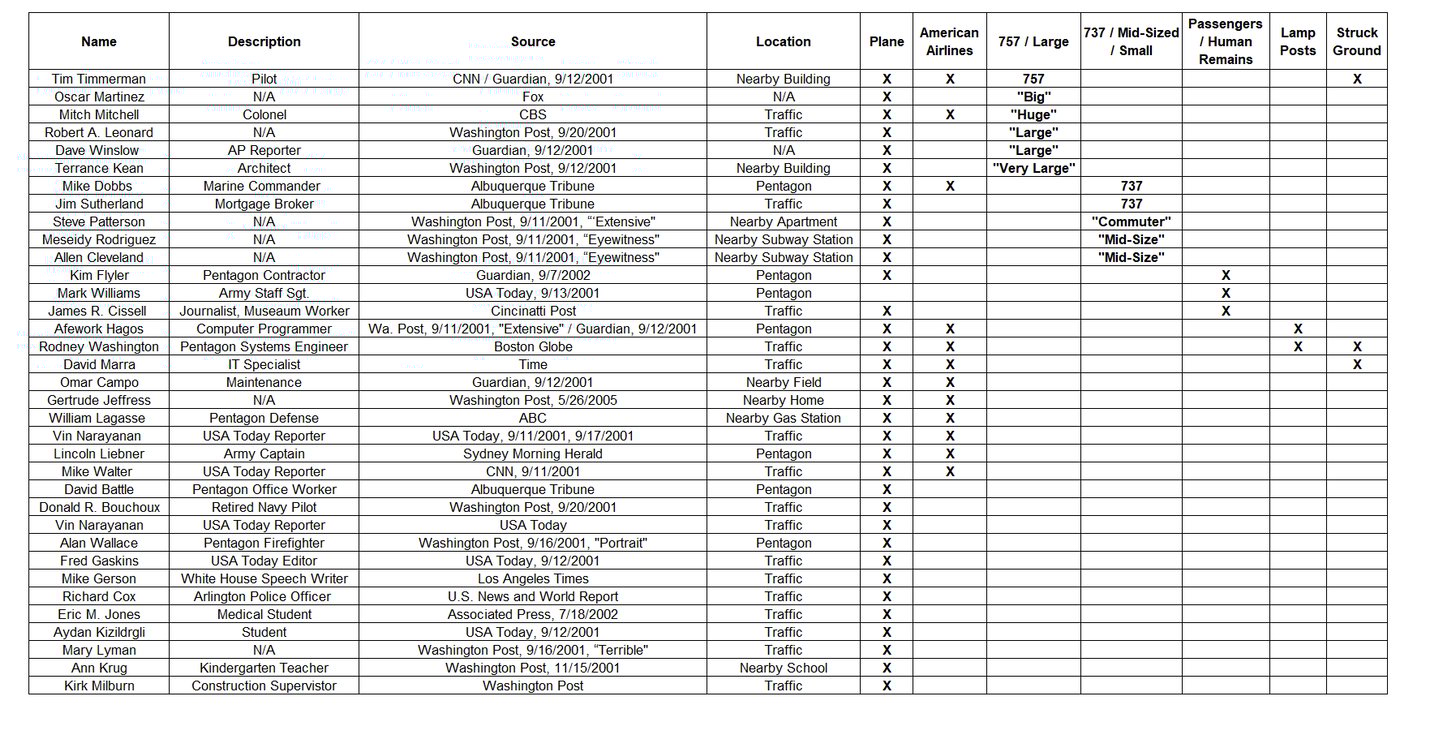
Dozens of eyewitnesses interviewed by mainstream media outlets saw an aircraft strike the Pentagon, with about a dozen of them specifying that they saw an American Airlines logo. A table summarizing many of these accounts is shown on the following page. Two of the witnesses documented in the table said the aircraft clipped lampposts on its approach and three of them said the plane struck the ground just before hitting the Pentagon.
There were conflicting accounts about the size of the aircraft, which is of interest to Honneger’s assertion that the aircraft could have been a retrofitted A−3 Sky Warrior drone. A Boeing 757 like Flight 77 has a minimum length of 155 feet and a wingspan of 124 feet. An A-3 Sky Warrior is about half that size with a minimum length of just 76 feet and a wingspan of 72 feet. However, an A-3 Sky Warrior is only about 20% smaller than a Boeing 737, which has a minimum length of 94 feet and a wingspan of 93 feet.
Eyewitnesses Oscar Martinez, Mitch Mitchell, Robert A. Leonard, Dave Winslow, and Terrance Kean respectively described the aircraft they saw as “big,” “huge,” “large,” “large,” and “very large.” Of particular interest were the interviews of pilot Tim Timmerman by CNN and the Guardian, although neither outlet specified whether he was a private, commercial, or military pilot or the extent of his experience. Nevertheless, Timmerman told CNN:
“I live on the 16th floor, overlooking the Pentagon, in a corner apartment, so I have quite a panorama… It was a Boeing 757, American Airlines, no question.”
By contrast, eyewitnesses Meseidy Rodriguez and Allen Cleveland both described the plane as “mid-sized” and Steve Patterson called it a “commuter [regional] jet,” which typically has less than 100 seats. Further, Marine Commander Mike Dobbs and mortgage broker Jim Sutherland both told Scripps Howard News Service (carried by the Albuquerque Tribune) that they saw a “Boeing 737.”
Finally, three eyewitnesses said they observed human beings or human remains. Pentagon worker Kim Flyler told the Guardian she “could see the silhouettes of people in the back two windows” of the aircraft, despite its airspeed of several hundred miles per hour. Likewise, James Cissell told the Cincinnati Post that as he sat in traffic:
“Out of my peripheral vision… I saw this plane coming in and it was… getting lower… I saw the faces of some of the passengers on board.”
Finally, Army Staff Sgt. Mark Williams told USA Today that he “discovered the scorched bodies of several airline passengers… still strapped into their seats.”
Sources:
ABC Nightline, 9/11/2002, Transcript: Interview with William Lagasse of the Pentagon’s Defense Protective Service
Albuquerque Tribune/ Scripps Howard News Service, 9/12/2001, “Mournful Church Bells Toll, Police Sirens Soar as D.C. Explodes Into Panic”
Associated Press, 7/18/2002, “2 Pentagon Heroes of 9/11 Honored”
BBC, 9/3/2001, “More Eyewitness Accounts of the Attack on the US”
Boston Globe, 9/12/2001, “After Assault on Pentagon, Orderly Response”
CBS, 9/13/2001, “The Early Show,” Interview of Colonel Mitch Mitchell
Cincinnati Post, 9/12/2001, “‘I Saw the Faces of Some of the Passengers’”
CNN, 9/11/2001, “America Under Attack: Israeli Prime Minister, Foreign Minister Offer Condolences to the American People,” Interview of Mike Walter of “USA Today Live”
CNN, 9/11/2001, “America Under Attack: Eyewitness Discusses Pentagon Plane Crash,” Transcript of Interview with Pilot Tim Timmerman
Fox News/Associated Press, 9/11/2001, “Hijacked Planes Used in Coordinated Attacks Upon New York, Washington”
Guardian, 9/12/2001, “‘Everyone Was Screaming, Crying, Running. It’s Like a War Zone’”
Guardian, 9/7/2002, “Pain, Fear and Disbelief”
Los Angeles Times, 9/11/2002, “Mike Gerson”
Sydney Morning Herald, 9/12/2001, “Flames, Bombs Strike at Symbolic Heart of a Nation”
Time, 9/12/2001, “Special Report: The Day of the Attack”
U.S. News and World Report, 12/2/2001, “The ‘Other’ Tragedy; The Attack on the Pentagon Left Heroes, Victims, Survivors, Here’s Their Story”
USA Today, 9/11/2001, “‘I fear for my daughter’”
USA Today, 9/12/2001, “Bush Vows Retaliation For ‘Evil Acts’”
USA Today, 9/13/2001, “Pentagon Searchers Encounter Grisly Scenes”
USA Today, 9/17/2001, “‘Tomorrow Always Belongs to Us,’” by Vin Narayanan (opinion)
Washington Post, 9/11/2001, “‘Extensive Casualties’ in Wake of Pentagon Attack”
Washington Post (online video), 9/11/2001, “Eyewitness to Pentagon Attack: Washington area residents Allen Cleveland and Meseidy Rodriguez were riding the metro and saw the plane that apparently crashed into the Pentagon.”
Washington Post, 9/12/2001, “Loud Boom, Then Flames In Hallways”
Washington Post, 9/16/2001, “Terrible Tuesday”
Washington Post, 9/16/2001, “Portrait of a Day That Began in Routine and Ended in Ashes”
Washington Post, 9/20/2001, “‘The Terrorists Cannot Kill Our Spirit’”
Washington Post, 11/15/2001, “After Attacks, Community Rallies Around Principal”
Washington Post, 5/26/2005, “Property’s Value Clouds Its Future”
Flight 77 Cockpit Voice Recorder Data Unrecoverable Despite Remarkably Robustness; Flight Data Recorder Said to Contradict Official Narrative
According to Newsweek, three days after 9/11 two firefighters discovered the Flight 77 flight data recorder and cockpit voice recorder – commonly known as the “rgb(0, 0, 0) box” – at four in the morning. The same day, per USA Today, the FBI was “confident the data [could] be recovered from both.” Their confidence was unsurprising since, according to NPR, rgb(0, 0, 0) boxes at a minimum must be able to withstand a 3,400 G-force and survive flames up to 2,000 degrees Fahrenheit for one hour. However, six months later the National Transportation Safety Board reported:
“No undamaged or usable segments of recording tape were found in the CVR recorder.”
On the other hand, data from the flight data recorder was purportedly recovered. In 2007, the organization “Pilots for 9/11 Truth” received this data in response to a Freedom of Information Act request. According to PR Newswire, the organization found that the data was remarkably inconsistent with the official Flight 77 narrative. First, the data stopped at least one second before impact. Second, the altitude of the aircraft was at least 300 feet higher than reported and should have flown right over the Pentagon. Third, the aircraft approached the Pentagon from a different direction than reported.
Pilots for 9/11 Truth generated a report signed by “fifteen professional pilots with extensive military and commercial carrier experience,” which included a computer animation of the flight path described by the data. Co-founder Robert Balsamo summarized:
“The information in the NSTB documents [containing the flight data recorder data] does not support, and in some instances factually contradicts, the official government position that American Airlines Flight 77 struck the Pentagon on the morning of September 11, 2001.”
Sources:
National Transportation Safety Board, 4/30/2002, “Specialist’s Factual Report of Investigation: [Flight 77] Cockpit Voice Recorder”
Newsweek, 9/27/2001, “Washington’s Heroes”
NPR, 3/11/2014, “What Would It Take To Destroy A Black Box?”
PR Newswire, 6/21/2007, “New Study from Pilots for 9/11 Truth: No Boeing 757 Hit the Pentagon”
USA Today, 9/14/2001, “Searchers Find Pentagon Black Boxes”
Remains of Flights 77 and 93 Secretly Incinerated; No Public Release of Inventory
In July and August of 2002, per the Washington Post, a series of secret memos produced by the Air Force and Army gave orders for remains from Flight 77 and Flight 93 to be incinerated. The article stated:
“The report cites Army and Air Force memos from July and August 2002 directing that an unspecified number of ‘remains from the Attack on the Pentagon’ be incinerated… The report indicates that unidentified remains from the hijacking of United Airlines Flight 93, which crashed in Shanksville, were disposed of in a similar manner.”
In August of 2005, the Daily Mail reported that:
“After most air disasters, the wreckage of the planes is meticulously gathered up and pieced together in search of clues… [yet] no evidence has ever been produced from the wreckage to prove that it was Flight 77 that hurtled into the side of the Pentagon at 350mph.”
In March of 2006, PR Newswire reported that Judicial Watch and the 9/11 Consensus Panel filed a Freedom of Information Act request with the Defense Department to publicize a complete inventory of the plane wreckage and debris from the four hijacked flights of 9/11.
In August of 2006, former Director of the CIA’s Office of Regional and Political Analysis, Bill Christison, wrote an essay in which he stated:
“[The wording of the 9/11 Commission causes] readers to assume that pieces of the aircraft and some bodies of passengers were found in the rubble of the [Flight 77] crash… [But] information so far released by the government does not show that such evidence was in fact found. The story put out by the Pentagon is that the plane and its passengers were incinerated [upon impact]…”
In February of 2007, the BBC reported that “trying to prove or disprove these alternative theories [regarding Flight 77 and Flight 93] is not easy” because “we found that simple requests, such as asking to see the plane wreckage of flight United 93 at Shanksville, or flight American Airlines 77 at the Pentagon, were refused after months of delay by the authorities.” The same report also quoted Senator Bob Graham, who co-chaired the 2002 Congressional Inquiry into 9/11, as stating that there was “collaboration of efforts among agencies and the administration to keep information out of the public’s hands.”
Sources:
BBC News, 2/14/2007, “9/11 Questions”
Bill Christison, 8/14/2006, “Stop Belittling the Theories About September 11”
Daily Mail, 2/9/2007, “An Explosion of Disbelief”
PR Newswire, 3/1/2006, “Experts Call for Release of 9/11 Evidence”
Washington Post, 2/28/2012, “Portions of 9/11 Victims’ Remains Taken to Landfill, Report Says”
FBI Briefly Releases Crash Site Photos 10 Years After 9/11, Withdraws, Then Releases Again After Another Six Years
In March of 2017, fifteen and a half years after 9/11, the FBI publicly released 27 photos from the Pentagon crash site. The release was covered by numerous media outlets, including ABC, Time, and Politico. Most of the photos showed first responders, cleanup crews, and/or damaged sections of the Pentagon. However, three of the photos purported to show pieces of metal debris with parts of an American Airlines logo.
Strangely, ABC News noted that the FBI briefly released the same photos in 2011, but then quickly removed them from its website. This was the year before the Washington Post broke the story that the military secretly incinerated Flight 77 remains in 2002. None of the outlets covering the 2017 photo release mentioned the incineration or that prior requests for debris access or a debris inventory had been rejected.
Sources:
ABC News, 3/31/2017, “FBI Re-Releases 9/11 Pentagon Photos”
Time, 3/31/2017, “FBI Releases Never-Before-Seen Photos From 9/11 Pentagon Attack”
Politico, 3/31/2017, “FBI Releases Never-Before-Seen Photos From 9/11 Pentagon Attack”
U.S. Officials Propose Staged Bombings, Hijackings, Downed Airliner to Justify Cuba Invasion; Decades Later, Some Theorize 9/11 Parallels
In March of 1962, the U.S. Joint Chiefs of Staff prepared a memorandum for the Defense Secretary which recommended various “false flag” scenarios for galvanizing public support for an invasion of Cuba. It was called “Operation Northwoods.” Some of the recommendations have been likened to aspects of 9/11 such as the loss of life, the hijacking of airliners, or the destruction of airliners.
For example, the fourth recommendation was to “develop a Communist Cuban terror campaign in the Miami area, in other Florida cities and even in Washington,” which included “exploding a few plastic bombs in carefully chosen spots… and the release of prepared documents substantiating Cuban involvement.”
The seventh recommendation was to give the appearance of the Cuban government condoning repeated “hijacking attempts against [U.S.] civilian air… craft” by Cuban terrorists.
The eighth recommendation was to fill a civilian aircraft secretly belonging to the CIA with military personnel that had been given “carefully prepared aliases,” such as “a group of college students off on a holiday.” Then an identical “duplicate [plane] would be substituted for the actual civil aircraft” which had been “converted to a drone.” The two planes would then “rendezvous south of Florida,” the populated plane would secretly land in “an auxiliary field at Eglin AFB,” and the “drone aircraft meanwhile will continue to fly the filed flight plan.”
Finally, the drone would transmit over the “the international distress frequency a ‘MAY DAY’ message stating he is under attack by Cuban MIG aircraft.” The transmission would then be “interrupted by destruction of the aircraft which will be triggered by radio signal.” Thus, radio stations in the Western Hemisphere would “tell the US what has happened to the aircraft instead of the US trying to ‘sell’ the incident.”
In August of 2005, the Daily Mail pointed out that some observers theorized some aspects of 9/11 could have paralleled Operation Northwoods. Likewise, in March of 2006, the San Francisco Chronicle reported that 9/11 Consensus Panel member, Nobel Prize nominee, Theology professor David Raye Griffin pointed to Operation Northwoods as “historical evidence” the U.S. government was capable of contriving false flags.
Sources:
Daily Mail, 8/6/2005, “9/11 on Trial”
San Francisco Chronicle, 9/3/2006, “The Conspiracy to Rewrite 9/11”
The Joint Chiefs of Staff, 3/13/1962, “Memorandum for the Secretary of Defense; Subject: Justification for US Military Intervention in Cuba,” A.K.A “Northwoods”