CHAPTER 20 - THE FIRST TWO FLIGHTS
Summary
(1) Flight 11 (the first hijack, which hit the WTC North Tower at 8:46) was considered to be a possible hijacking by Boston Flight Control at 8:15 (AP) and known with certainty at 8:24 (Com-pg. 19, NYT, Guardian). FAA protocol called for immediate notification up the FAA chain and over to the NMCC at the first 8:15 suspicion (FAA, MSNBC, Com-pg. 17-18, Guardian). However, as we have already seen, the FAA did not open up its standard protocol “hijack phone bridge” with the NMCC until after the first WTC impact at 8:46 and the NMCC did not join it until 9:20, departing from its 30-plus year track record of immediate promptness.
Nevertheless, NORAD’s northeastern facility – NEADS – became aware of the Flight 11 hijack sometime between 8:31 and 8:40 when Boston Flight Control made one or more out-of-protocol phones call directly to NEADS (NORAD, Com-pg. 20, Com-FAA HQ Site Visit MFR, ABC News). NEADS then gave an out-of-protocol scramble order to Otis Air National Guard Base (Com-pg. 20) (188 miles east of New York City (Clarke)) at 8:46 (the same time that Flight 11 impacted WTC North Tower), which put two F-15 fighters in the air by 8:53 (Com-pg. 20).
(2) At 8:42, New York Air Traffic Control realized that Flight 175’s radio contact ceased, the transponder was turned off, and the plane veered off course. This was immediately noticed by New York controllers (FAA, NYT). However, the 9/11 Commission ridiculously claimed that New York controllers did not notice any issue with Flight 175 until between 8:47 to 8:51 (Com-pg. 7) despite publicly available controller transcripts to the contrary (FAA, NYT).
The fact that New York controllers noticed Flight 175’s emergency status at 8:42 almost certainly means it was also noticed by Boston controllers since Flight 175 was still in Boston’s region at the time (NTSB). Correspondingly, the FAA notified NEADS at 8:43 that Flight 175 was hijacked (NORAD, WAPO). This notification was almost certainly due to the fact that the NEADS tech team responsible for facilitating FAA-NEADS communications (Vanity Fair) linked their headsets into the Boston Center, in whose region Flight 175 was still traveling, so they could hear everything Boston controllers heard/said in real-time, according to Newhouse News’ interview with the head of that team, Master Sergeant Maureen Dooley (Newhouse News-Dooley).
Despite all this, the 9/11 Commission ridiculously claimed the first NEADS notification of Flight 175 came from New York controllers at 9:03 (Com-pg. 23).
(3) The 9/11 Commission omitted from public release any NEADS or Boston controller tapes or transcripts in the vicinity of 8:43 (Rutgers, NYT) and the FAA legally gagged Boston controller from speaking publicly about the events of 9/11 (New York Observer). In fact, it also omitted any NEADS or Boston controller tapes or transcripts from 8:33 onward (Rutgers, NYT) even though the first hijacked flight – Flight 11 – traveled in Boston’s region for almost its entire post-hijack approach to the World Trade Center before impacting at 8:46 (NTSB). There appears to have been a concerted effort to keep from the public what was known and what was discussed inside the Boston Air Traffic Control Center during this rgb(0, 0, 0)out period.
(4) As stated, NEADS put two Otis Air National Guard Base F-15 fighters in the air by 8:53. The F-15’s were capable of reaching New York in approximately ten minutes (Boston Globe, Cape Cod Times, Slate), meaning they may have had enough time to intercept Flight 175 before it impacted the South Tower at 9:03. They did not have permission to shoot down, but NORAD’s standard response to a hijacking is a graduated one. A fighter can first rock the plane’s wingtips or make a pass in front of it or fire tracer rounds in its path, potentially spooking the hijackers and forcing them to turn out to sea (Slate).
(5) Conflicting reports said the fighters flew anywhere between 1200 and under 600 mph (ABC, BBC, MSNBC, NORAD) – the latter being slower than the cruising speed of a commercial airliner. Regardless, the 9/11 Commission said the Otis fighters were sent to a holding pattern at sea because they were never given information about their targets (Com-pg. 20). It then said the NEADS tapes of the technicians who controlled the Otis scramble were unavailable due to a technical issue (Com-pg. 459 FN 120).
(6) At the New York Air Traffic Control Center, after the 9/11 attacks concluded, six air traffic controllers who dealt with the hijacked airliners were recorded sharing their recollections of the morning’s events. The tape was to be sent to the FBI. The FAA issued an order for all such material to be preserved. However, a Quality Assurance Manager shredded the tape and discarded it into multiple trash cans around the building (NYT (x2), WAPO (x2)). The Transportation Department Inspector General gave him a slap-on-the-wrist 20-day suspension, would not speculate on his motivation, and implied the tape contained nothing to hide (U.S. DOT).
(7) In a bizarre anomaly, not one of the eight commercial airline pilots killed on 9/11 punched the standard 4-digit hijack code into their transponders – an action which takes only seconds (ABC, CNN, FAA, Christian Science Monitor).
(8) According to U.S. Army Magazine, the Director of the New York State Emergency Management Office, and multiple mainstream media reports (UPI, Philadelphia Daily News, Counterpunch) citing two reputable eyewitnesses (NYT) and an unnamed source at the National Transportation Safety Board, the FBI recovered 3 of the 4 rgb(0, 0, 0) boxes from Flights 11 and 175. However, the 9/11 Commission Report, FBI, and National Transportation Safety Board officially claimed no rgb(0, 0, 0) boxes were ever recovered.
(9) Days after 9/11, the passport of one of the terrorists aboard Flight 11 was found unsinged on the street blocks away from ground zero (AP, ABC, CNN, Guardian).
(1) Sources:
ABC News, 9/11/2002, “9/11: Interviews by Peter Jennings” (transcript)
Associated Press, 8/12/2002, “FAA Controllers Detail Sept. 11 Events”
FAA Order JO 7110.65Y (“Air Traffic Control”), Section 1 (“General”), Paragraph 10-1-1 (“Emergency Determinations”)
FAA Order JO 7110.65Y (“Air Traffic Control”), Section 2 (“Emergency Assistance”), Paragraph 10-2-5 (“Emergency Situations”)
Guardian, 10/17/2001, “‘We Have Plane. Stay Quiet’ – Then Silence”
Guardian, 9/6/2003, “This War on Terrorism is Bogus”
MSNBC, 9/12/2001, “What Was Needed to Halt the Attacks”
New York Times, 10/16/2001, “‘We Have Some Planes,’ Hijacker Told Controller”
NORAD, 9/18/2001, “NORAD’s Response Times” press release
Richard Clarke, 2004, “Against All Enemies: Inside America’s War on Terror,” pg. 5
9/11 Commission, 2/6/2003, “Memorandum for the Record: FAA OPS Center Visit”
9/11 Commission, July 2004, “9/11 Commission Report,” pg. 17-20
(2) Sources:
FAA, 9/17/2001, “Summary of Air Traffic Hijack Events”
National Transportation Safety Board, 2/19/2002, “Flight Path Study – United Airlines Flight 175”
New York Times, 10/16/2001, “Transcript of United Airlines 175”
Newhouse News, 1/25/2002, “Amid Crisis Simulation, ‘We Were Suddenly No-Kidding Under Attack’”
NORAD, 8/18/2001, “NORAD’s Response Times” (press release)
Vanity Fair, 10/17/2006, “9/11 Live: The NORAD Tapes”
Washington Post, 9/12/2001, “Timeline in Terrorist Attacks of Sept. 11, 2001”
(3) Sources:
National Transportation Safety Board, 2/19/2002, “Flight Path Study – American Airlines Flight 11”
New York Observer, 6/21/2004, “9/11 Tapes Reveal Ground Personnel Muffled Attacks”
New York Times, 10/16/2001, “Transcript of United Airlines 175”
Rutgers University Law Review, 9/7/2011, “Full Audio Transcript”
(4) Sources:
Boston Globe, 9/11/2005, “Two Pilots Revisit Their 9/11”
Cape Cod Times, 8/21/2002, “‘I Thought It Was the Start of World War III’”
Slate, 1/16/2002, “IGNORAD: The Military Screw-Up Nobody Talks About”
(5) Sources:
ABC News, 9/11/2002, “9/11: Interviews by Peter Jennings” (transcript)
BBC, 9/1/2002, “Clear the Skies”
MSNBC, 9/23/2001, “Chain of Events at NORAD on September 11”
NORAD, 8/18/2001, “NORAD’s Response Times” (press release)
9/11 Commission, 2004, “9/11 Commission Report,” pg. 20, 476 (footnote 120)
(6) Sources:
New York Times, 5/6/2004, “F.A.A. Official Scrapped Tape of 9/11 Controllers’ Statements”
New York Times, 5/7/2004, “Tape of Air Traffic Controllers Made on 9/11 Was Destroyed”
Washington Post, 5/6/2004, “FAA Managers Destroyed 9/11 Tape”
Washington Post, 5/7/2004, “Controllers’ 9/11 Tape Destroyed, Report Says”
U.S. Department of Transportation, Office of Inspector General, 5/4/2004, “Destruction of Audiotape – Summary Findings and Recommendations”
(7) Sources:
ABC News, 6/3/2005, “Hijack Code a Secret Signal of Distress”
Christian Science Monitor, 9/12/2001, “The Nation Reels”
CNN, 9/12/2001, “America Under Attack: How Could It Happen?”
FAA, 7/12/2001, “Order 7610.4J: Special Military Operations, Chapter 7. ESCORT OF HIJACKED AIRCRAFT”
(8) Sources:
Army Magazine, February 2002, “AMC: Accelerating the Pace of Transformation”
Counterpunch, 12/19/2005, “9/11: Missing Black Boxes in World Trade Center Attacks Found by Firefighters, Analyzed by NTSB, Concealed by FBI”
New York State Emergency Management Office, 9/18/2001, “World Trade Center Plane Crash” (memorandum from Director Edward Jacoby to Governor George Pataki)
Philadelphia Daily News, 10/28/2004, “New Cover-up revealed? 9/11 Black Boxes Found”
United Press International, 10/28/2004, “UPI Hears…”
9/11 Commission, July 2004, “9/11 Commission Report,” Ch. 1 Footnote 76, pg. 456
(9) Sources:
Associated Press, 9/16/2001, “Suspected Hijacker’s Passport Found”
ABC News, 9/16/2001, “No Signs of Survivors, Recovery Efforts Intensify; FBI Launches ‘Grid’ Search”
CNN, 9/18/2001, “Ashcroft Says Nore Attacks May Be Planned”
Guardian, 3/18/2002, “Uncle Sam’s Lucky Finds”
9/11 Commission, 8/21/2004, “9/11 and Terrorist Travel” (Staff Report)
Flight 11 Not Intercepted After Delayed Hijack Notification
Flight 11 took off from Boston around 8 AM. It was the first plane to be hijacked. Edited transcripts of the cockpit transmissions show that the last routine communication between Flight 11 and Boston’s air traffic control was at 8:13, followed immediately by loss of radio contact. The 9/11 Commission Report on page 18 said that Boston flight controllers knew something was wrong, but did not interpret this as a possible hijack. However, before Boston flight controllers were legally gagged (per the New York Observer), Boston air traffic manager Glenn Michael told the Associated Press:
“We considered [Flight 11] at that time [8:15] to be a possible hijacking.”
At 8:20, Flight 11 stopped transmitting its IFF (identify friend or foe) beacon signal, and was clearly off course. At 8:21, the transponder was turned off, which gives flight controllers a plane’s exact location and altitude. However, flight controllers could still track its approximate location using primary radar, so the flight was never lost. Boston flight controller Mark Hodgkins told ABC News (9/6/2002):
“I watched the target of American 11 the whole way down.”
With the transponder off, Boston flight control determined Flight 11 had probably been hijacked, yet failed to notify their FAA superiors. FAA regulations instructed air traffic controllers:
“Consider that an aircraft emergency exists… when:… There is unexpected loss of radar contact and radio communications with any… aircraft… If… you are in doubt that a situation constitutes an emergency or potential emergency, handle it as though it were an emergency.”
Furthermore, MSNBC pointed out that a significant course deviation is “considered a real emergency” and requires fighters to be scrambled. Nevertheless, no emergency response action was taken at 8:21.
Flight 11’s pilot, Captain John Ogonowski, began intermittently turning the talk-back button off and on, which enabled flight controllers to hear what was being said in the cockpit. At 8:24 (per 9/11 Commission Report pg. 19, New York Times, Guardian, etc.), Boston flight controllers heard the hijackers tell the passengers:
“We have some planes. Just stay quiet and you will be OK. We are returning to the airport… Everything will be OK. If you try to make any moves you’ll endanger yourself and the airplane. Just stay quiet.”
At this point, Boston flight controllers had no doubt the plane had been hijacked. At 8:25, Boston flight control began to pass news of the hijacking up the FAA chain of command, with FAA Headquarters being notified at 8:32, per the 9/11 Commission report.
There were disputing accounts of when NORAD first learned of the Flight 11 hijack. Within a week of the attacks, the FAA and NORAD both reported that NEADS (NORAD’s regional facility) was notified of the hijacking at 8:40. It was not clear what communication channel the 8:40 notification referred to. As discussed previously, proper protocol during a hijacking was for the FAA to initiate the “hijack net” phone bridge with the NMCC, which acted as a required liaison between the FAA and NORAD. However, the hijack net was not initiated until after the first WTC impact at 8:46 and the NMCC did not join until 9:20. Therefore, the 8:40 notification must have referred to an out-of-protocol call made directly from an FAA entity to a NORAD entity.
In any event, the 9/11 Commission rejected the 8:40 notification report by FAA and NORAD, instead citing the following 8:37 recorded conversation between Boston Flight Control and NEADS as the first alert NORAD received concerning Flight 11:
FAA: “Hi. Boston Center TMU [traffic management unit], we have a problem here. We have a hijacked aircraft headed towards New York, and we need you guys to, we need someone to scramble some F-16s or something up there, help us out.”
NEADS: “Is this real-world or exercise?”
FAA: “No, this is not an exercise, not a test.”
With an 8:37 alert time and an 8:46 World Trade Center impact, the 9/11 Commission report formalized a nine-minute advance notice that NORAD had to respond to Flight 11. It then stated, despite extensive official documentation, sworn testimony, and firsthand witness statements to the contrary (as we have covered in previous chapters), that nine minutes was the most advance notice NORAD received of any of the hijacked flights. The report stated:
“In summary, NEADS received notice of the hijacking nine minutes before it struck the North Tower. That nine minutes’ notice before impact was the most the military would have of any of the four hijackings.”
In contrast, ABC News (9/11/2002) reported one year after the attacks that NEADS employee Lt. Colonel Dawne Deskins was first notified at 8:31. Deskins was interviewed by the 9/11 Commission and remembered being contacted early that morning by Boston Flight Control, but no time was specified in the interview notes. However, the ABC News report harmonized with a statement contained in the memorandum from the 9/11 Commission staff’s official site visit to FAA headquarters in February of 2003, which stated:
“First call to NORAD was from Boston Center to OTIS AFB between 8:30-8:34 a.m. The supervisor was being ‘entrepreneurial.’”
In any event, according to Newhouse News, shortly after NEADS became aware of the hijacking its technicians’ headsets linked into Boston Flight Control, which enabled them to hear everything about both Flight 11 and Flight 175 at the same time Boston did.
Flight 11 impacted the World Trade Center at 8:46. Flight 175 impacted at 9:03. Flight 77 impacted the Pentagon at 9:37. Flight 93 crashed in Shanksville, Pennsylvania at 10:03. This means that Flights 175, 77, and 93 crashed 17 minutes, 51 minutes, and 77 minutes after Fight 11, respectively.
White House Terrorism Advisor Richard Clarke pointed out in his 2004 book Against All Enemies that there were two Air Force bases in the Northeast region that were formally part of NORAD. One was Otis Air National Guard Base on the Cape Cod peninsula of Massachusetts, about 188 miles east of New York City. The other was Langley Air Force Base near Norfolk, Virginia, about 129 miles south of Washington.
On 9/11, NORAD said six minutes passed between when it became aware of the first hijacking (8:40) and when it gave the scramble order to the Otis F-15 fighters (8:46). Once the scramble order was given, it was an additional 7 minutes before the fighters were airborne (8:53), per the 9/11 Commission Report. A NORAD spokeswoman cited by the Cape Cod Times said F-15 fighters from Otis could reach New York City in 10 to 12 minutes, but if they flew at their top speed of 1875 mph (per Slate), they could have spanned the 188-mile distance in just 6 minutes. That puts a fighter jet from Otis in New York City potentially within 6+7+6 = 19 minutes.
There was officially no way for the FAA to gain approval for NORAD assistance at any point during the entire 9/11 attacks since the NMCC did not join the hijack net until 9:20 and Defense Secretary Donald Rumsfeld did not enter the NMCC until nearly 10:30. However, per the 9/11 Commission Report (pg. 20), NEADS battle commander Colonel Robert Marr sought permission directly from his commanding General Larry Arnold to scramble the Otis fighters, to which Arnold replied:
“Go ahead and scramble them, and we’ll get authorities later.”
Arnold then called NORAD headquarters to report on the situation.
If NORAD had been notified of a possible hijacking at 8:13 when Boston Flight Control suspected as much, or at 8:20 when the IFF signal turned off and the plane was significantly off course, then fighter jets could certainly have reached New York before either WTC impact. If NORAD had been notified NORAD at 8:25 when a hijacking was certain, fighter jets could very likely have reached New York before the first WTC impact and definitely before the second. As it happened, with NORAD first being notified sometime between 8:31 and 8:40, the fighters did not receive the scramble order until 8:46 and were not airborne until 8:53, seven minutes after Flight 11 struck the North Tower.
Sources:
ABC News, 9/14/2001, “Timeline of Disaster: From Flight School Training to Buildings Collapsing”
ABC News, 9/6/2002, “Witness to Tragedy: Air Traffic Controllers Haunted by Memories of Sept. 11”
ABC News, 9/11/2002, “9/11: Interviews by Peter Jennings” (transcript)
ABC News, 9/14/2002, “Moments of Crisis, Part 1: Terror Hits the Towers: How Government Officials Reacted to Sept. 11 Attacks”
Associated Press, 8/12/2002, “FAA Controllers Detail Sept. 11 Events”
Cape Cod Times, 9/16/2001, “Did Hijackers Fly Through Holes in US Air Defense”
FAA, 9/17/2001, “Summary of Air Traffic Hijack Events”
FAA Order JO 7110.65Y (“Air Traffic Control”), Section 1 (“General”), Paragraph 10-1-1 (“Emergency Determinations”)
FAA Order JO 7110.65Y (“Air Traffic Control”), Section 2 (“Emergency Assistance”), Paragraph 10-2-5 (“Emergency Situations”)
Guardian, 10/17/2001, “‘We Have Plane. Stay Quiet’ – Then Silence”
MSNBC, 9/12/2001, “What Was Needed to Halt the Attacks”
New York Observer, 6/21/04, “9/11 Tapes Reveal Ground Personnel Muffled Attacks”
New York Times, 10/16/2001, “‘We Have Some Planes,’ Hijacker Told Controller”
Newhouse News, 1/25/2002, “Amid Crisis Simulation, ‘We Were Suddenly No-Kidding Under Attack’”
NORAD, 9/18/2001, “NORAD’s Response Times” press release
Richard Clarke, 2004, “Against All Enemies: Inside America’s War on Terror,” pg. 5
Slate, 1/16/2002, “IGNORAD: The Military Screw-Up Nobody Talks About”
9/11 Commission, 2/6/2003, “Memorandum for the Record: FAA OPS Center Visit”
9/11 Commission, 10/30/2003, “Memorandum for the Record: Interview with Lt. Col. Dawne Deskins”
9/11 Commission, 6/17/2004, “Transcript, 9/11 Commission staff statement no. 17: Improvising a Homeland Defense”
9/11 Commission, July 2004, “9/11 Commission Report,” pg. 1-2, 4-6, 18-21, 32
NORAD Reportedly Learns of Flight 175 Hijack at 8:43, Commission Says 9:03; Flight Controllers Muzzled, Fighters Given No Target
Flight 175 took off from Boston at 8:14. At 8:41, Flight 175 told New York Air Traffic Control that it heard a suspicious transmission which later turned out to be a hijacker aboard Flight 11. At 8:42, New York air traffic controllers realized that Flight 175’s radio contact ceased, the transponder was turned off, and the plane veered off course. At 8:44, they realized Flight 175’s emergency locator transmitter (ELT) had been activated, which suggested a hijack. The following flight traffic control transcript was published by the New York Times (10/16/2001). I have designated all non-Flight 175 speakers “FAA” rather than various controller codes:
“Following is a transcript of the radio communications between the New York Air Route Traffic Control Center… and United Airlines Flight 175 (UAL175)… The transcripts were obtained by The New York Times .”
8:41:32 UAL175: “We figured we'd wait to go to your center. We heard a suspicious transmission on our departure from BOS sounds like someone keyed the mike and said everyone stay in your seats.”
8:41:51 FAA: “O.K. I'll pass that along.”
8:42:03 FAA: “UAL 175 just came on my frequency and he said he heard a suspicious transmission when they were leaving BOS everybody stay in your seats that's what he heard as the suspicious transmission just to let you know.”
8:42:50 FAA: “…where do you place [UAL 175]… now?”
8:42:55 FAA: “He’s [UAL 175] off about 9 o'clock and about 20 miles looks like he’s heading southbound but there's no transponder no nothing and no one's talking to him.”
8:44:05 FAA: “I just picked up an ELT (emergency locator transmitter) on 121.5 it was brief but it went off.”
8:44:09 FAA: “O.K. they said it's confirmed...”
The FAA’s 9/17/2001 press release entitled “Summary of Air Traffic Hijack Events” likewise summarized each of these transmissions.
Notice Flight’s 175’s first statement: “We figured we’d wait to go to your center.” What does this mean? It almost certainly means that Flight 175 had already previously communicated this information to Boston flight controllers. This is because Flight 175 had always been, and still was, in the Boston controllers’ region of jurisdiction, not New York controllers’ region, as we are about to see.
According to NORAD’s 9/18/2001 press release, the FAA notified NEADS at 8:43 that Flight 175 was hijacked. This was immediately after Flight 175’s radio contact ceased, the transponder was turned off, and the planed veered off course. And less than a minute before its emergency locator transmitter (ELT) had been activated. The communication channel was not specified, but it was likely the result of NEADS technicians listening in on Boston Flight Control, as we are about to see.
Master Sergeant Maureen Dooley was the head of the “ID Tech” team on the NEADS operations floor, overseeing Senior Airman Stacia Rountree and Tech Sergeant Shelley Watson. Per Vanity Fair, their job was “to facilitate communications between NEADS, the civilian F.A.A., and other military commands.” Newhouse News interviewed and frequently quoted Dooley for a January 2002 article on the NEADS operations floor during the attacks. About halfway through the article, it stated:
“At 8:43 a.m., Dooley’s technicians, their headsets linked to Boston Center, heard of a second plane, United Flight 175, that also was not responding. It, too, was moving to New York.”
This statement is not a direct quote, but in the context of the interview, the information almost certainly came from Dooley herself.
Likewise, the day after 9/11, the Washington Post published a timeline that included the following entry:
“8:43 a.m.: The FAA notified military authorities of a second hijacking.”
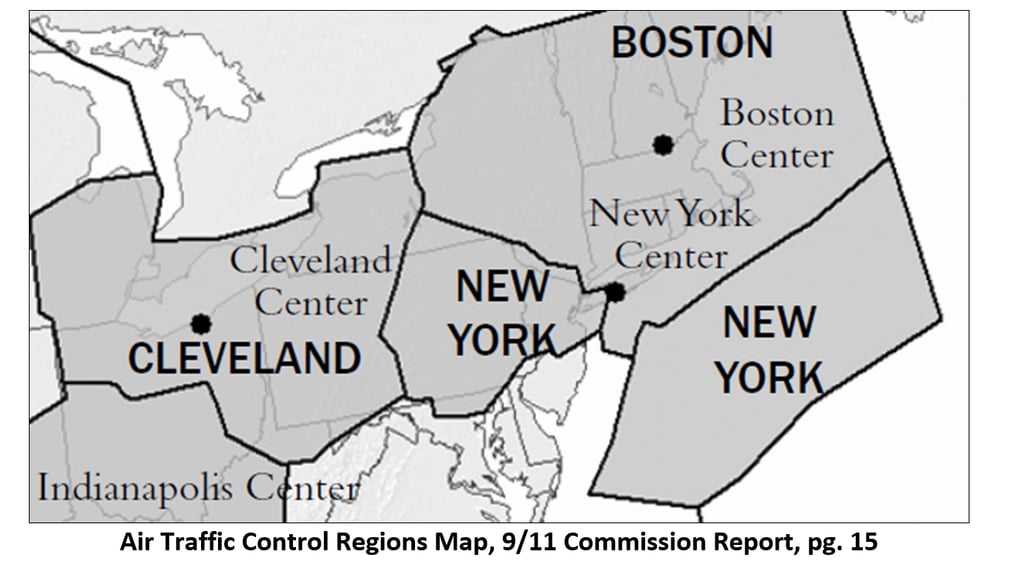
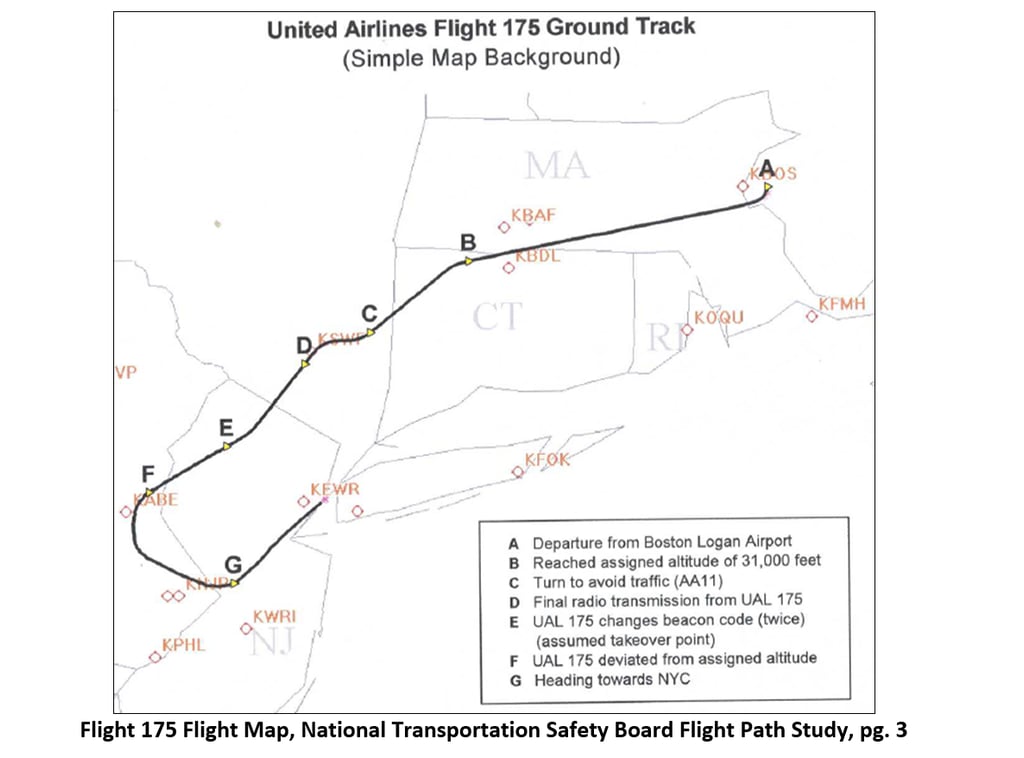
Comparing Flight 175’s route (page 3 of the National Transportation Safety Board’s flight path study) with the Air Traffic Control Regions map (page 15 of the 9/11 Commission Report), the plane was still in the Boston controller’s region during its 8:41 communication to New York and its radio loss, transponder signal loss, course deviation, and ELT activation between 8:42 and 8:44. However, it was approaching the boundary between the Boston and New York regions. Thus it would have routinely been in communication with both control centers while it was being “handed off” from Boston to New York. Likewise, Boston and New York controllers may have been in communication with one another during the handoff. Therefore, NORAD’s press release combined with Newhouse News’ interview of Master Sergeant Dooley makes logistical sense.
However, the 9/11 Commission Report formalized a different story. It could be summarized by these three statements:
“The hijackers attacked between 8:42 and 8:46.” (pg. 7)
“The first operation evidence that something was abnormal on United 175 came at 8:47, when the aircraft changed beacon codes twice within a minute. At 8:51, the flight deviated from its assigned altitude, and a minute later, New York air traffic controllers began repeatedly and unsuccessfully trying to contact it.” (pg. 7)
“The first indication that… NORAD… had of the second hijacked aircraft, United 175, came in a phone call from New York to NEADS at 9:03… about the time the plane was hitting the South Tower.” (pg. 23)
Incredibly, the 9/11 Commission completely ignored the New York controllers’ discussion of Flight 175’s radio loss, transponder signal loss, course deviation, and ELT activation between 8:42 and 8:44. Further, it ignored NORAD’s 9/18/2001 press release and Master Sergeant Dooley’s firsthand testimony that NEADS first learned of the hijack at 8:43 by listening on Boston controllers. Further, according to the New York Observer, the FAA forbade the Boston flight controllers from speaking publicly about the events of 9/11.
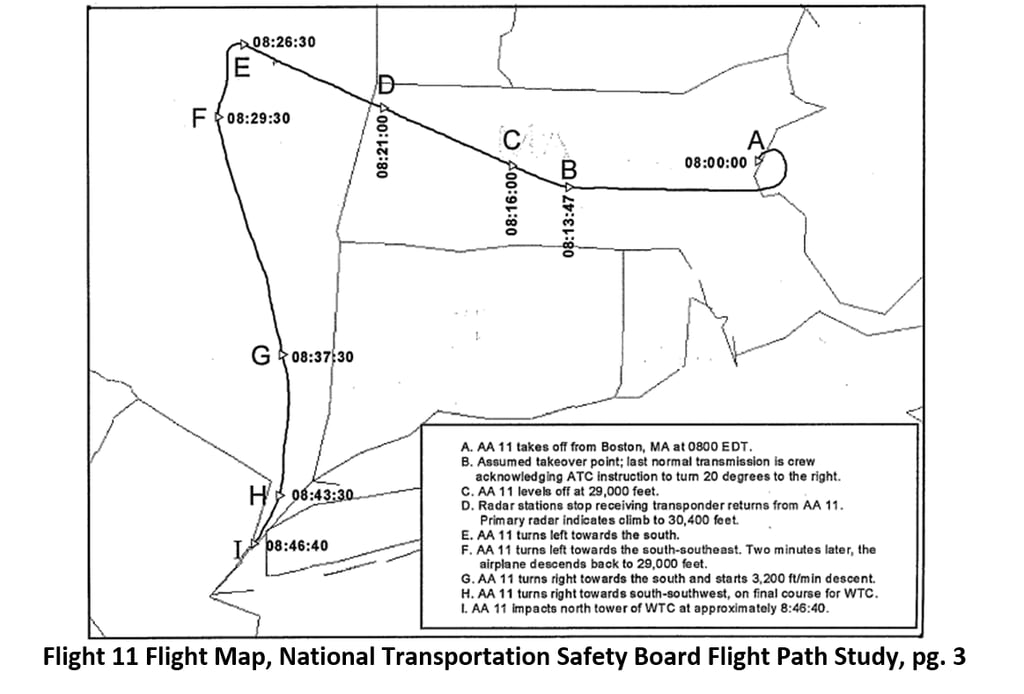
Further, the NTSB flight path study for Flight 175 omitted any Boston controller transmissions to or about Flight 175 after 8:39 even though it was in Boston’s region until about 8:45. Further, the publicly released National Transportation Safety Board (NTSB) flight path study for Flight 11 omitted all Boston controller transmissions to or about Flight 11 after 8:33 even though it was in Boston’s region virtually its entire flight until just before 8:46 impact. (See Flight 11’s route, compared with the previous shown Air Traffic Control regions map.) There appears to have been a concerted effort to keep from the public what was known and what was discussed inside the Boston Air Traffic Control Center during these blackout periods. And remember, from 8:43 onward, NEADS reportedly heard everything Boston heard and said.
Furthermore, when the 9/11 Commission eventually publicly released 114 civilian and military flight traffic recordings/transcripts in 2011 (via Rutgers Law School and the New York Times), it included the 9:03 New York to NEADS call, but did not include any calls/transmissions from Boston Air Traffic Control or Master Sergeant Dooley’s team in the vicinity of 8:43, which might have debunked its narrative.
Further still, during their October 2003 interview of Dooley, Rountree, and Watson, the 9/11 staff started with the assumption that NEADS did not hear of Flight 175 until the New York Center’s 9:03 call. The “9/11: United Airlines Flight 175 (UAL 175)” section of the interview memorandum began:
“According to information provided to the Commission staff by NEADS, at 13:03:20 UTC [9:03 EST] there was a report of a possible second hijacking. The other aircraft is identified as UAL 175. Roundtree received that information from ZNY [New York Center].”
The memorandum then proceeded chronologically from there, never looking backward to a possible 8:43 notification. Likewise, the 9/11 Commission report completely omitted any reference to Dooley’s team linking in to Boston’s headsets or hearing of Flight 175’s hijacking at 8:43 (perfectly corroborating NORAD’s 9/18/2001 press release.) Instead, it stated on page 23:
“The first indication that NORAD air defenders had of the second hijacked aircraft, United 175, came in a phone call from New York Center to NEADS at 9:03. The notice came at about the time the plane was hitting the South Tower.”
To the extent that NORAD’s press release and Newhouse News’ report were accurate, it appears the 9/11 Commission perpetrated a cover-up to hide the fact that NEADS learned of Flight 175’s hijack at 8:43, potentially leaving enough time for fighters to intercept it before its 9:03 impact.
(In contrast to both the 8:43 and 9:03 notification times, NEADS’ logbook claimed it was not notified of Flight 175 until 9:05. This log entry was also cited by the FAA’s 9/17/2001 press release and by NORAD’s Colonel Allan Scott’s May 23, 2003 testimony before the 9/11 Commission.)
In any event, as noted by the 9/11 Commission, Flight 175’s transponder came back on at 8:46, but with a different signal that was not assigned to any commercial flight, and New York Center flight controllers began trying to contact it at 8:51. According to transcripts cited by Vanity Fair, the New York controllers then labeled the flight on the radar screen with an “I” for “intruder” and about half a dozen of them watched it carefully for the remainder of its flight, offering guesses as to where it was headed. Some thought the Newark Airport for an emergency landing. One guessed it was targeting the Statue of Liberty for a suicide crash.
As stated in the previous section, the two F-15 fighter jets from Otis Air National Guard Base were airborne 8:53, ten minutes before Flight 175 hit the South Tower. Also as stated, according to the Cape Cod Times, a NORAD spokeswoman said fighters from Otis could reach New York City in 10 to 12 minutes, so Fight 175 was still potentially reachable.
If the F-15’s traveled at their top speed of 1875 mph (per Slate), they would have spanned the 188 miles from Otis to New York in just 6 minutes, meaning they would have arrived at 8:59, four minutes before impact. However, the Boston Globe reported:
“[Pilots] Duffy and Nash were flying F-15 Eagles that were built in 1977. In their prime, the planes can go Mach 2.5; they could have been to New York in less than 10 minutes. Because of their age and the three large fuel tanks they were carrying, though, the planes couldn't attain that speed, both pilots said.”
In the first couple of years following the 9/11 attacks, there were widely varying accounts of how fast the Otis fighters flew to New York. Most of them at least reported faster than Mach 1 (the speed of sound), which is about 750 mph. Lead pilot Lt. Col. Timothy Duffy told BBC:
“I was supersonic.… I don’t know what we could have done to get there any quicker.”
He also told ABC News:
“[We flew] supersonic on the way, which is kind of nonstandard for us.”
ABC News (9/11/2002) concluded the two fighters flew “at Mach 1.2, nearly 900 miles per hour.” However, according to the Boston Globe, one of the pilots stated he flew at about Mach 1.4 – more than 1,000 miles per hour. NORAD Continental Commander Major General Larry Arnold told MSNBC:
“[They flew at] about 1.5 Mach, which is, you know, somewhere—11 or 1,200 miles an hour.”
However, NORAD’s 9/18/2001 press release said the trip took 19 minutes, which meant the fighters would have had to average less than 600 mph – not only subsonic, but slower the cruising speed of a commercial airliner!
Major General Arnold appeared to sidestep this inconsistency in his interview with MSNBC by claiming it didn’t matter that the F-15’s didn’t reach the airliners in time since a shoot-down order had not yet been authorized. However, Slate magazine pointed out that this statement omitted the fact that NORAD’s standard response to a hijacking is a graduated one. The approaching fighter can first rock the plane’s wingtips or make a pass in front of it or fire tracer rounds in its path, potentially spooking the hijackers and forcing them to turn out to sea.
Finally, in July of 2004 the 9/11 Commission report said the 19-minute fighter trip from Otis to New York was due to the Otis fighters being sent into a holding pattern off the coast of New York to await information about their target, where they remained until after Flight 175’s impact at 9:03.
Sources:
ABC News, 9/11/2002, “9/11: Interviews by Peter Jennings” (transcript)
BBC, 9/8/2002, “Clear the Skies”
Boston Globe, 9/11/2005, “Two Pilots Revisit Their 9/11”
Cape Cod Times, 8/21/2002, “‘I Thought It Was the Start of World War III’”
FAA, 9/11/2001, “Chronology ADA-30, Operation Center; Terrorist Attacks NY-DC 9/11/01”
FAA, 9/17/2001, “Summary of Air Traffic Hijack Events”
MSNBC, 9/23/2001, “Chain of Events at NORAD on September 11”
National Transportation Safety Board, 2/19/2002, “Flight Path Study – American Airlines Flight 11”
National Transportation Safety Board, 2/19/2002, “Flight Path Study – United Airlines Flight 175”
New York Observer, 6/21/2001, “9/11 Tapes Reveal Ground Personnel Muffled Attacks”
New York Times, 10/16/2001, “Transcript of United Airlines 175”
New York Times, 9/7/2011, “Newly Published Audio Provides Real-Time View of 9/11 Attacks”
Newhouse News, 1/25/2002, “Amid Crisis Simulation, ‘We Were Suddenly No-Kidding Under Attack’”
Newsday, 9/10/2002, “A Loss of Control”
NORAD, 8/18/2001, “NORAD’s Response Times” (press release)
Rutgers University Law Review, 9/7/2011, “Full Audio Transcript”
Slate, 1/16/2002, “IGNORAD: The Military Screw-Up Nobody Talks About”
Vanity Fair, 8/1/2006, “9/11 Live: The NORAD Tapes”
Washington Post, 9/12/2001, “Timeline in Terrorist Attacks of Sept. 11, 2001”
9/11 Commission, 5/23/2003, 9/11 Commission Public Hearing Transcript (NORAD’s Colonel Alan Scott testimony; Commissioner Ben-Veniste statement)
9/11 Commission, 10/27/2003, “Memorandum for the Record: Interview with Personnel from Huntress ID” (participants: Dooly, Rountree, Watson)
9/11 Commission, 2004, “9/11 Commission Report,” pgs. 7-8, 21-22
9/11 Commission Selectively Publicizes Recordings/Transcripts that Support Its Narrative; Omit Boston 8:43 and Otis Scramble Tapes
How is possible that NEADS technicians did not carefully track Flights 175 on primary radar for twenty minutes after learning of its hijacking at 8:43, exactly the same time as Boston Flight Control, which they listening in on? And how is it possible that this tracking information was not communicated to the Otis fighters? These questions should have been easily answerable by reviewing recordings and transcripts both from NEADS and Boston Flight Control. However, Chapter 1, footnote 120 of the 9/11 Commission Report (pg. 459) contained the following statement:
“Because of a technical issue, there are no [NEADS] recordings available of the [NEADS] senior weapons director and weapons director technician position responsible for controlling the Otis scramble.”
And how did the 9/11 Commission deal with NORAD’s press release stating that it became aware of the Flight 175 hijack at 8:43, corroborating Newhouse News’ interview with NEADS’ Master Sergeant Maureen Dooley? By not releasing the NEADS and/or Boston Center recordings or transcripts that potentially would have proved it accurate. When Rutgers Law School (of which 9/11 Commission Lead Investigator John Farmer was the Dean) in September of 2011 released the previously discussed 114 time-stamped transcripts and audio recordings from 9/11, they completely omitted any record of what was discussed by Boston Flight controllers or NEADS’ Master Sergeant Maureen Dooley’s team in the vicinity of 8:43 when they reportedly learned of Flight 175’s hijacking.
Sources:
New York Times, 9/7/2011, “Newly Published Audio Provides Real-Time View of 9/11 Attacks”
New York Times, 9/7/2001, “The 9/11 Tapes: The Story in the Air”
Rutgers University Law Review, 9/7/2011, “Full Audio Transcript”
9/11 Commission, 2004, “9/11 Commission Report,” Ch. 1, Footnote 120 (pg. 476)
Air Traffic Controllers’ Tape-Recorded 9/11 Testimony Is Destroyed
According to the Washington Post (5/6/2004, 5/7/2004) and the New York Times (5/6/2004, 5/7/2004), just before noon on 9/11, shortly after the attacks had run their course, 16 people, including at six air traffic controllers who dealt with the hijacked airliners, gathered in a meeting room at the New York Air Route Traffic Control Center on Long Island. For one hour, the Center’s manager, Mike McCormick, passed around a microphone to each attendee to record their recollections of the morning’s events. McCormick intended to forward the tape to the FBI. However, after the recording session, the Center’s Quality Assurance Manager, Kevin Delaney, took custody of the tape.
Three days later an FAA directive was e-mailed the New York Center which stated:
“Retain and secure until further notice ALL administrative/operational data and records.… If a question arises whether or not you should retain the data, RETAIN IT.”
The next month, according to the 2004 Transportation Department Inspector General’s report on the incident, Kevin Delaney repeatedly assured the local vice president of the National Air Traffic Controllers Association that he would “get rid” of the tape. Also, when one of the air traffic controllers who was recorded asked Delaney to listen to the tape as she was preparing her written statement regarding the attacks, Delaney refused.
In November, the New York Center submitted its formal post-9/11 accident package of evidence to FAA headquarters in Washington, D.C., but deliberately excluded the tape. Then, sometime between December 2001 and February 2002, Delaney crushed the cassette containing the recording, shredded the tape, and discarded it into multiple trash cans around the building without anyone having ever transcribed, duplicated, or listened to it.
Delaney later claimed he did this for three reasons:
He said the controllers “were not in the correct frame of mind to have properly consented to the taping” due to the stress of the day’s events.
He said some details in the tapes contradicted the controllers’ subsequent written statements.
He said it was a violation of FAA post-incident procedures to tape-record controllers’ statements since only written statements were to be prepared. However, the Inspector General’s report said this was incorrect.
Nevertheless, Inspector General’s report concluded:
“We do not ascribe motivations to the managers in this case of attempting to cover-up, and we have no indication there was anything on the tape that would lead anyone to conclude that they had something to hide or that the controllers did not properly carry out their duties on September 11.”
Delaney was disciplined with a 20-day suspension without pay.
The same Inspector General report said the FAA was not deliberately uncooperative with the 9/11 Commission. However, per the Washington Post (8/2/2006), at that same time the report was being issued, the Commission members debated asking the Justice Department to conduct a criminal probe of the FAA after it withheld documents for two years. The New York Times (10/26/2003) said the FAA “had withheld dozens of boxes of documents involving the Sept. 11 attacks.” But the Inspector General concluded:
“We have also investigated FAA’s reported lack of responsiveness in the period leading up to the Commission’s issuance of the subpoena... We found that miscommunications and misunderstandings led to concerns that FAA had not been thorough enough in its production of materials pursuant to the Commission’s requests.”
Sources:
New York Times, 10/26/2003, “9/11 Commission Could Subpoena Oval Office Files”
New York Times, 5/6/2004, “F.A.A. Official Scrapped Tape of 9/11 Controllers’ Statements”
New York Times, 5/7/2004, “Tape of Air Traffic Controllers Made on 9/11 Was Destroyed”
Washington Post, 5/6/2004, “FAA Managers Destroyed 9/11 Tape”
Washington Post, 5/7/2004, “Controllers’ 9/11 Tape Destroyed, Report Says”
Washington Post, 8/2/2006, “9/11 Panel Suspected Deception by Pentagon”
U.S. Department of Transportation, Office of Inspector General, 5/4/2004, “Destruction of Audiotape – Summary Findings and Recommendations”
No 9/11 Hijacked Flights Follow Protocol to Squawk Universal Hijack Code
On 9/11, according to ABC News, not one of the four hijacked commercial airliners followed standard hijack procedures by squawking the universal hijack code – 7500 – from the transponder. Chapter 7 of the FAA’s “Special Military Operations” manual says:
“To facilitate NORAD tracking, every attempt shall be made to ensure that the hijacked aircraft is squawking Mode 3/A, code 7500.”
The Christian Science Monitor called the eight pilots’ protocol breach an “anomaly,” and stated:
“…the four-digit hijack code… [is something] a pilot would normally send the moment a hijack situation was known.”
Likewise, CNN reported:
“Airline pilots are trained… [in] dialing in an emergency four digit code on a device called a transponder.”
The Christian Science Monitor speculated that the transponder “may have been… deactivated in order to keep a pilot from notifying the ground that the plane had been hijacked…”
However, CNN pointed out the action only “takes seconds.” Therefore, the action arguably should have been achievable in the time between when pilots first became aware the hijackers were trying to enter the cockpit and the time when the pilots could no longer access the transponder punch keys. For example, in the case of Flight 93, the Los Angeles Times reported that two cockpits tapes played for the jury of the 2006 Zacarias Moussaoui trial indicated there were around 30 seconds of time during which the pilots knew a hijacking was underway and could still access the transponder punch keys.
Sources:
ABC News, 6/3/2005, “Hijack Code a Secret Signal of Distress”
Christian Science Monitor, 9/12/2001, “The Nation Reels”
CNN, 9/12/2001, “America Under Attack: How Could It Happen?”
FAA, 7/12/2001, “Order 7610.4J: Special Military Operations, Chapter 7. ESCORT OF HIJACKED AIRCRAFT”
Los Angeles Times, 4/12/2006, “Heroism, Fatalism Aboard Flight 93”
Media, Army, NY EMO Say WTC Black Boxes Found; Commission, FBI, NTSB Deny
According to Time magazine, all commercial airliners carry two virtually indestructible “rgb(0, 0, 0) boxes” – a Flight Data Recorder (FDR) and a Cockpit Voice Recorder (CVR). The FDR records the plane’s speed, altitude, and course, while the CVR records conversation inside the cockpit and the plane’s external communications. They are designed to withstand intense heat and violent crashes. They emit signals for investigators to track are almost always found after commercial airliner crashes, even in the depths of the ocean.
According to CBS News and the 9/11 Commission Report, the four rgb(0, 0, 0) boxes from Flights 11 and 175, which struck the WTC Towers, were never found. This position was also taken by the FBI and National Transportation Safety Board.
However, according to multiple reports, a well-known Red Cross medic named Mike Bellone, whose efforts were detailed by the New York Times, and a Ground Zero FDNY fireman Nicholas DeMasi reportedly found three of the four rgb(0, 0, 0) boxes. The FBI then took custody of them, denied it, and then gave them to the National Transportation Safety Board, which also denied it. United Press International wrote:
“The official account published by the 9/11 commission is coming under increasing attack as a whitewash. Contradicting the 9/11 commission's report, two men who worked extensively in the wreckage of the World Trade Center following the 9-11 attacks claim they helped federal agents find three of the four airliner rgb(0, 0, 0) box’ flight recorders from the jetliners that struck the towers.”
The Philadelphia Daily News wrote:
“New York City firefighter Nicholas DeMasi has written… that he escorted federal agents on an all-terrain vehicle in October 2001 and helped them locate three of the four rgb(0, 0, 0) boxes. His account is supported by a volunteer, Mike Bellone, whose efforts at Ground Zero have been chronicled in the New York Times…”
Counterpunch Magazine wrote:
“Mike Bellone and Nicholas De Masi, claimed in 2004… that Federal agents took them and told the two men not to mention having found them. … A source at the National Transportation Safety Board… says the boxes were in fact recovered and were analyzed by the NTSB. ‘Off the record, we had the boxes,’ the source says. ‘You’d have to get the official word from the FBI as to where they are, but we worked on them here.’”
Corresponding to these reports, on September 18, 2001, the Director of the New York State Emergency Management Office, Edward Jacoby, generated a now-public memorandum to New York Governor George Pataki with the subject line, “World Trade Center Plane Crash.” The first bullet point under the executive summary states:
“Investigators have identified the signal from one of the rgb(0, 0, 0) boxes in the WTC debris.”
Finally, the February 2002 issue of Army Magazine stated:
“Radio frequency detectors developed at CECOM [Communications Electronics Command] were used to find ‘rgb(0, 0, 0) box’ flight recorders from the airliners that crashed into the two towers.”
Sources:
Army Magazine, February 2002, “AMC: Accelerating the Pace of Transformation”
CBS News, 2/25/2002, “Speed Likely Factor in WTC Collapse”
Counterpunch, 12/19/2005, “9/11: Missing Black Boxes in World Trade Center Attacks Found by Firefighters, Analyzed by NTSB, Concealed by FBI”
New York State Emergency Management Office, 9/18/2001, “World Trade Center Plane Crash” (memorandum from Director Edward Jacoby to Governor George Pataki)
Philadelphia Daily News, 10/28/2004, “New Cover-up revealed? 9/11 Black Boxes Found”
Time, 7/2/2009, “A Brief History of Black Boxes”
United Press International, 10/28/2004, “UPI Hears…”
9/11 Commission, July 2004, “9/11 Commission Report,” Ch. 1 Footnote 76, pg. 456
Flight 11 Terrorist Passport Found Blocks from Ground Zero Days Later
Less than one week after 9/11, the Associated Press, ABC, and CNN reported that the passport of Satam al Suqam – one of the terrorists aboard Flight 11 – had been recovered on the streets of New York within blocks of ground zero. ABC News specified that the passport was discovered by FBI investigators. However, a 9/11 Commission staff report asserted nearly three years later that an anonymous passerby found the passport and handed it to an NYPD Detective who then gave it to the FBI. In any event, six months after the attacks, the Guardian (which mistakenly said the passport belonged to Mohamed Atta) skeptically commented:
“…the idea that [the] passport had escaped from that inferno unsinged would have tested the credulity of the staunchest [FBI] supporter…”
Sources:
Associated Press, 9/16/2001, “Suspected Hijacker’s Passport Found”
ABC News, 9/16/2001, “No Signs of Survivors, Recovery Efforts Intensify; FBI Launches ‘Grid’ Search”
CNN, 9/18/2001, “Ashcroft Says Nore Attacks May Be Planned”
Guardian, 3/18/2002, “Uncle Sam’s Lucky Finds”
9/11 Commission, 8/21/2004, “9/11 and Terrorist Travel” (Staff Report)