CHAPTER 5 - THE WITNESSES
Summary
Over two dozen sources provided broad agreement that the FAA provided useful, timely information regarding Flights 77 and 93 to NORAD, the White House/Secret Service, and the Pentagon and that fighter jets were scrambled from Langley Air Base at 9:24 in response to one or both of these flights. Several are official FAA/NORAD/Air Force records or chronologies. Several others are highly detailed firsthand accounts by FAA/NORAD/White House/Secret Service officials. However, the 9/11 Commission Report asserted that virtually every detail of every one of these accounts was false.
Over Two Dozen Sources (Including Many First-Hand Witnesses) Agree FAA Provided Useful Real-Time Information on Flights 77 & 93; Commission Rejects All of It
In contradiction to the 9/11 Commission’s official narrative, an abundance of officials and official sources provided broad agreement that the FAA provided useful, timely information regarding Flights 77 and 93 to NORAD, the White House/Secret Service, and the Pentagon and that fighter jets were scrambled from Langley Air Base at 9:24 in response to one or both of these flights. Let’s begin by returning to FAA Administrator Jane Garvey’s (and Mr. Asmus’ and Ms. Schuessler’s) May of 2003 document read aloud by Commissioner Ben-Veniste. It said the following about what information was shared by the FAA over the 9/11 hijack net:
“The FAA shared real-time information on the phone bridges about the unfolding events, including information about loss of communication with aircraft, loss of transponder signals, unauthorized changes in course, and other actions being taken by all the flights of interest, including Flight 77.”
“Other parties on the phone bridges in turn shared information about actions they were taken. NORAD logs indicate that the FAA made formal notification about American Flight 77 [the same time as the Langley scramble] at 9:24 a.m. But information about the flight was conveyed continuously during the phone bridges before the formal notification.”
Similarly, during the June of 2004 public hearing, Commissioner Lehman heatedly (and ridiculously) asked FAA Deputy Administrator Monte Belger why the FAA did not provide timely information to the NMCC for Flights 77 and 93 through an out-of-protocol conference that the NMCC initiated apart from the FAA. Belger’s reply implied this information was appropriately provided through the hijack net. He stated:
Commissioner Lehman: “There was no notification of multiple hijackings… There was no notification of the military on 93. There was no direct communication with NORAD from headquarters… The communications with NMCC, which you have said was where the focus of headquarters was, was never established during the critical period.”
Monte Belger: “As I said before, the National Military Command Center was entered into the hijacking at 9:20 in the morning. That net’s there for everybody to listen, real-time, to hear what’s going on. So – I mean, that's just a fact… The FAA has the latest communication capability. I don't know who [the NMCC] called, but our intelligence folks were right there next to the operations center… at 9:20, the NMCC was called… In my 30 years of history, there was always somebody listening to that net.”
Belger also emphasized in his 9/11 Commission staff interview that the FAA provided timely military alerts of Flight 77 and 93 and that the Langley scramble was executed in response to the latter. The memorandum from his interview stated:
“Langley fighters, according to Belger, were scrambled for ‘the unidentified aircraft that later turned out to be AAL 77…’”
“Belger then told Commission staff that he recollects that at the time UAL 93 was in distress ‘everybody including the military was following it real-time… [because] the primary net had been set up…’”
“He holds the position that the NMCC was on the primary net, and thus ‘notified’ of UAL 93.”
Additionally, Transportation Secretary Norman Mineta repeatedly told the media that he and Monte Belger tracked Flight 77’s location in real-time as it approached Washington D.C. In a 2002 MSNBC interview with Robert Hager, Mineta stated:
“So we went running down and went into the PEOC which is the bunker, as you know, under the White House… I started to establish a direct line to the FAA to find out what was going on, and the Vice President and I were across from each other on the conference room table in the PEOC… it was probably about 9:27… someone said, ‘Mr. Vice President, there's a plane 50-miles out.’
So I was talking to Monte Belger, the Deputy Director of the FAA, and I said, ‘Monte, what do you have 50-miles out?’ He said, ‘Well, we have a target, bogey, on the radar, but the transponder's been turned off, so we have no identification of this aircraft…’ So then someone came in, the same person came in and said, ‘Mr. Vice President… the plane’s 30-miles out.’
“…And so then the person came in and said, ‘Mr. Vice President, the plane's ten miles out,’ and so I said, ‘Monte, where is it?’ and he said, ‘Well, I'm not really sure…’ And then pretty soon he said, ‘Oh-oh, we just lost the target.’ And so a few moments later, someone came in and said, ‘Mr. Vice President, there's been an explosion at the Pentagon.’”
Likewise, Mineta stated on an ABC News special in September of 2002:
“Someone came in and said Mr. Vice President, there’s a plane out 50 miles. And so I said, Monty, what do you have? He said, well we’re watching this target on the radar, but the transponder’s been turned off. So we, have no identification. Someone came in and said, Mr. Vice President, the airplane's 30 miles out. The fellow came in and said, it’s ten miles out… He said, uh-oh, we just lost the bogey, meaning the target went off the screen. So I said, well, where is it? And he said, well, we’re not really sure.”
Mineta also testified before the 9/11 Commission in May of 2003 of this same exchange between Cheney and his aid in the PEOC sometime after 9:20 as Flight 77 was approaching Washington D.C.
Further, FAA Crisis Management Supervisor Michael Weikert, who personally ran the primary hijack net, told the 9/11 Commission staff during his interview:
“NMCC is the conduit to the Special Operations [fighter jet support] groups. We were trying to raise them [fighter jet support] when we were tracking the plane [Flight 77] that crashed in the Pentagon. Belger was in the room at the time. He was monitoring both nets [tactical and primary]. ATC [Air Traffic Control – also on the net] was monitoring 93. It was heading toward Washington… They were monitoring the event through the net.”
NORAD agreed that it received useful information regarding Flights 77 and 93. On September 18, 2001, NORAD publicly released a document entitled, “NORAD’s Response Times.” Regarding the FAA’s notification to the military of Flight 77 and the subsequent Langley scramble, the document stated:
“FAA Notification to NEADS 0924
Fighter Scramble: Order (Langley AFB, Hampton, Va. 2 F-16s) 0924”
Further, the document said the FAA’s notification time for Flight 93 was “N/A” or not applicable, because by then:
“The FAA and NEADS established a line of open communication discussing AA Flt 77 and UAL Flt 93.”
These entries corresponded with an August of 2002 FAA press release entitled, “Fact Sheet: Chronology of Events on September 11, 2001 (August 2002)”. The press release stated:
“0924. The FAA notifies NORAD’s Northeast Air Defense Sector about the suspected hijacking of American Flight 77. The FAA and NORAD establish an open line to discuss American 77 and United 93.”
Correspondingly, in October of 2001 NORAD Commander Eberhart testified before the Senate Armed Services Committee and had the following exchange with Senator Wayne Allard:
Levin: “General Eberhart… The time line that we've been given is that… at 9:25, the FAA notified NORAD that flight 77 was headed toward Washington…”
Eberhart: “Sir, there is one minor difference. I show it as 9:24 that we were notified, and that's the first notification that we received…”
Allard: “Then FAA continued to notify NORAD that you had two other potential hijackings, these headed for Washington; is that correct?”
Eberhart: “Yes, sir… we were working that with the FAA and we launched the airplanes out of Langley Air Force Base as soon as they notified us about hijacking… United Airlines flight 93 in Pennsylvania…we were trying to decide, initially, if that flight was going to continue west and if there was some other target for that flight… It dropped off their radar scope… And then they reacquired it. And at that time it became obvious to us that… it was headed probably for Washington, D.C…”
(Two and a half years later, Eberhart flip-flopped on this position under threat of being prosecuted for false testimony, as we will discuss in a future chapter.)
Also, in May of 2003, Air Force Vice Commander Colonel William Scott and Air Force Secretary Major General Craig McKinley testified together of the following:
Scott: “At 9:09… at about that same time, kind of way out in the West, is when America 77, which in the meantime has turned off its transponder and turned left back toward Washington, appears back in radar coverage. And my understanding is the FAA controllers now are beginning to pick up primary skin paints on an airplane, and they don't know exactly whether that is 77, and they are asking a lot of people whether it is, including a C-130 that is westbound toward Ohio…
9:16, now FAA reports a possible hijack of United Flight 93, which is out in the Ohio area…
At 9:24 the FAA reports a possible hijack of 77. That's sometime after they had been tracking this primary target. And at that moment as well is when the Langley F-16s were scrambled out of Langley.
At 9:25, America 77 is reported headed towards Washington, D.C., not exactly precise information, just general information across the chat logs… At 9:30 the Langley F-16s are airborne. They are 105 miles away from the Washington area…
“At 9:37 we have the last radar data [of Flight 77] near the Pentagon. And 9:40, immediately following that, is when 93 up north turns its transponders off out in the West toward Ohio, and begins a left turn back toward the East…
At 10:02, United 93 last radar data and the estimated impact time for United 93 is 10:03.”
McKinley: “Mr. Chairman, we thought right up front we'd put that on the record… this is the… continental NORAD region timeline… this is the best and most accurate data that we could piece together…”
Further, just minutes after Colonel Scott’s and Major General McKinley’s statements, NORAD Continental Commander Major General Larry Arnold likewise testified:
“…9:24 was the first time that we had been advised of American 77 as a possible hijacked airplane. Our focus… was on United 93, which was being pointed out to us very aggressively I might say by the FAA.”
“…the second aircraft crashed into the tower… And then very shortly thereafter we got a call from on the United 93 flight being a possible hijacking. And that aircraft, as you -- well, I don't know if you know, but it wandered around. That aircraft wandered around and flew up over the northern part of Pennsylvania and Ohio.”
“…in the record you see the [9:24] time when we were notified of the American Flight 77 as being a possible hijack… And we had launched almost simultaneously with that, we launched the aircraft out of Langley to put them over top of Washington, D.C., not in response to American Airline 77, but really to put them in position in case United 93 were to head that way.”
About one week after the May of 2003 hearing, Colonel Scott e-mailed Major General Arnold’s subordinate – NORAD’s Northeastern sector (NEADS) Commander Colonel Robert Marr – to ask for clarify about whether the Langley fighters were scrambled in response to Flight 77 or Flight 93. Colonel Marr would have known better than anyone since he was the one who gave the scramble order. He e-mailed the following reply on June 2, 2003, which was later quoted verbatim in a letter by the 9/11 Commission to the DOD and DOT Inspectors General:
“The answer on AA77 is not easy, nor is it pretty. At the time AA77 was occurring we were focused on UAL93 which was the only confirmed hijack that the FAA had identified to us. My records show UAL93 reported as hijacked at 0916L, once we found it and identified it’s [sic] westerly heading, we scrambled Langley at 0924L just in case it turned around toward DC, which it did later. At 0924L we also received a call from the FAA about AA77 with a follow-up call at 0925L. It is easiest to explain the simultaneous scramble order with the AA77 notification as the scramble being against AA77 - it takes a lot of time to explain to the public that you're scrambling fighters against a plane heading away from the possible target.”
Similarly, Marr told the 9/11 Commission staff in his January of 2004 interview that he considered both Flight 77 and Flight 93 to have been potential threats to Washington D.C. and ordered the scramble to protect Washington D.C. The memorandum from Marr’s interview stated:
“Marr’s memory of AA 77… was that he had received information on a threat perceived on Washington, D.C. and on the White House.”
“Marr noted that much going on led him to believe Washington was at risk, and he commented that in his recollection UAL 93 was hijacked.”
“Marr noted that he decided to scramble in response to a variety of events that occurred… [and to] protect the NCA [National Command Authority – i.e. the Pentagon and the White House].”
Correspondingly, the man responsible for executing Marr’s scramble order – Senior Airmen Tracking Technician Lieutenant Jeremy Powell – likewise recalled tracking Flights 77 and 93 on radar shortly after the scramble. The memorandum from his staff interview stated:
“One of Powell's lines is used specifically for NEADS scrambles. This was used on 9/11 for Langley, which launched three fighters… Powell commented that after the scrambles of Langley AFB… NEADS addressed the tracking of the AA 77 (American Airlines Flight 77) and UAL 93… Powell specifically remembers watching the AA 77 track into the Pentagon.”
Also, as Commissioner Ben-Veniste pointed out in the June of 2004 hearing, the Air Force’s official record of the 9/11 attacks published in 2003 by the Tyndall Air Force Base Public Affairs Office under the name, “Air War Over America: Sept. 11 Alters Face of Air Defense Mission,” told the same story. For example, on page 63, it stated:
“With little time to grasp what had happened in New York, the FAA continued to report more shocking information in the Northeast sector: American Airlines Flight 77… [was a] possible hijacked. Somewhere over Cleveland, United Airlines Flight 93 bound for San Francisco was still off course. ‘The FAA is starting to report more aircraft not following their flight plans,’ [NEADS Commander Colonel Robert] Marr says. ‘Now we are looking at a host of potential problems.’ …The [Langley] pilots were still in their cockpits at Langley Air Force Base. At the squadron operations desk… Craig Borgstrom took a terse phone call from NEADS… The active air scramble order had been given. It was 9:24…”
The book also contained harmonious quotations from both Major General Arnold and Colonel Marr. Page 59 quoted Arnold as saying that shortly after the 2nd WTC impact, “we were getting calls about United Flight 93…”
On pages 71-73 Arnold described the following conference call with the FAA and his three subordinate commanders over the Northeastern, Western, and Southeast NORAD sectors (Colonels Robert Marr, John Cromwell, and Larry Kemp, respectively.) The book said of Arnold, Marr, Cromwell, and Kemp:
“They were making fast decisions as the FAA reported more information.”
It then quoted Arnold as stating:
“We were concerned about Flight 93… and were trying to find aircraft in the vicinity to help out. We didn’t know where it was going to go. We were concerned about Detroit… Then we watched the 93 track as it meandered around the Ohio-Pennsylvania area and started to turn south toward D.C. By now the Pentagon has been hit and we have aircraft on orbit… (from the Langley alert detachment). They are now orbiting over Washington, D.C, and have been for awhile. As United 93 headed toward D.C., the desire is to move the fighters toward those aircraft. But as we discussed it in the conference call, we decided not to move fighters toward 93 until it was closer because there could have been other aircraft coming in… [However,] I had every intention of shooting down United 93 if it continued to progress toward Washington.”
Arnold also told the 9/11 Commission during his testimony:
“…at one time we thought either the Delta flight [falsely reported as a possible hijack] or the United 93 might pose a threat to Detroit. We tried to get airplanes airborne out of the Toledo Air National Guard at that particular time. ‘Can you get anything airborne? Because we have this United 93 and this Delta. We need to intercept it and see what is going on with those particular aircraft...”
(Arnold later flip-flopped on this position under threat of being prosecuted for false testimony, as we will discuss in a future chapter.)
Similarly, page 68 quoted Marr speaking about earlier moments in the same teleconference before Flight 93 turned around toward Washington D.C. Marr stated:
“We don’t have fighters that way and we think [Flight 93 is] headed toward Detroit or Chicago. I’m thinking Chicago is the target and know that Selfridge Air National Guard Base (Mich.) had F-16s in the air. We contacted them so they could head off 93 at the pass. The idea is to get in there, close in on him and convince him to turn… As United Airlines Flight 93 was going out, we received clearance to kill if need be. In fact, Major General Arnold’s words almost verbatim were: ‘We will take lives in the air to save lives on the ground.’”
Corresponding to this, the memorandum from Marr’s interview with the 9/11 Commission staff stated:
“Marr commented that he remembered directing the staff in general to look for more fighters… He recalled eventually getting fighters that were training in Selfridge. He noted that those fighters were… directed to UAL 93.”
“Marr commented that he distinctly remembers watching the flight UAL 93 come west, and turn over Cleveland.”
Marr related the same anecdote to ABC News one year after 9/11 and even emphasized how clearly he remembered the presidential shoot-down order that Major General Arnold passed down. Marr stated:
“I got the call and I, the words [Major General Arnold spoke] that I remember as clear as day was, ‘we will take lives in the air to preserve lives on the ground.’ And we of course passed that on to the pilots [two F-16 pilots on a training mission from Selfridge Air National Guard Base near Detroit]. United Airlines Flight 93 will not be allowed to reach Washington, DC.”
“So we were able to get hold them on the radios and say, hey guys, we may need you to come down south and try and head off United Airlines Flight 93. The real scary part is that those guys are up there on a training mission. They don't have any weapons on board they can use.”
“The first question that came from my mission crew commander, the individual that’s in charge of the operations force, said, ‘well, sir, what are they gonna do?’ I said, ‘we’re gonna put them as close to that airplane they can get, in view of the cockpit, and convince that guy in that airplane that he needs to land… [If that doesn’t work] as military men, there are, times you have to make sacrifices, that you have to make [implying the pilots would be asked to crash into the hijacked plane].”
Likewise, in a March of 2005 interview with Newhouse News, Marr gave another detailed description of the moments leading up to and during his conversation with the Selfridge mission crew commander. The article stated:
“United Airlines 93 was flying parallel to Delta Flight 1989 over Pennsylvania and heading west. Both were thought to be hijacked, Marr says. ‘At that time, we didn't have any fighters out there… I directed the battle staff to look for anyone who was out there, anyone who could help us out.’”
“Two [unarmed] Air National Guard fighters had just taken off from Selfridge Air National Guard Base [on a training mission] near Detroit and were heading north along Lake Michigan. The two fighters were ordered south in case United Airlines 93 was targeting Chicago. Marr remembers thinking, ‘OK, we got the World Trade Center out, but the Sears Tower is over there…’”
“The [Selfridge] mission crew commander asked Marr what they were going to do. ‘I said, ‘We’re going to have the fighters fly as close to the cockpit as we can and we’re going to convince that airliner that he can’t get to Chicago and he needs to put down someplace else,’’ Marr recalls.”
“And if they don't comply? ‘And I said, ‘Then we’ll talk about what we have to ask those pilots to do,’’ Marr says. ‘Yes, there were unarmed people in the air and, let’s face it, you do what you've got to do if you're going to protect the populace. You’re in the military.’”
Lieutenant Powell also corroborated Marr’s and Arnold’s recollections about looking for fighter support out west to intercept Flight 93 before it turned back toward Washington D.C. His staff interview memorandum stated:
“Powell called the air defense bases to the west to assess their air defense capability… He asked Selfridge in a recorded conversation to vector the aircraft flying training exercises in the Pike Gauntlet airspace towards Pennsylvania… NEADS knew that the Pennsylvania aircraft was a hijack, thus he moved to position assets in that area.”
Additionally, Secret Service agent Barbara Riggs during a 2006 interview at Cornell University stated:
“Through monitoring radar and activating an open line with the FAA, the Secret Service was able to receive real time information about other hijacked aircraft. We were tracking two hijacked aircraft as they approached Washington, DC, and our assumption was that the White House was a target. While the White House was evacuated, the Secret Service prepared to defend the facility.”
Correspondingly, Vice President Cheney stated on NBC’s Meet the Press:
“Flight 77… turned back and headed back towards Washington. As best we can tell, they came initially at the White house… Didn't circle it, but was headed on a track into it. The secret service has an arrangement with the FAA, they had open lines after the World Trade Center was [hit].”
Likewise, the Secret Service agent in charge of presidential movements, Nelson Garabito, contacted his FAA counterpart, Terry Van Steenbergen, at FAA headquarters just after the second WTC impact. At this point several critical actions unfolded:
The two immediately agreed that the White House needed protection and all incoming aircraft should be considered hostile.
Steenbergen informed Garabito that two additional planes were considered potential hijacks (almost certainly referring to Flight 77 and 93) and one of them had already turned around and was heading toward Washington D.C. This could only refer to Flight 77.
Steenbergen’s subordinates immediately, successfully contacted Langley and Andrews Air Force to request fighters be scrambled. After this Steenbergen was confident Langley was scrambling fighters.
Garabito called down the PEOC.
Garabito received presidential shoot-down authorization, which he passed to Steenbergen.
The two tracked Flight 77’s real-time position during its final approach to Washington D.C.
Garabito’s statement and interview notes are contained in a 9/11 Commission document dated July 28, 2003 and entitled, “USSS Statement and Interview Reports”. Steenbergen’s notes are contained in his 9/11 Commission interview memorandum. It is explicit from the notes that actions 1 through 4 and 6 all occurred before the Pentagon impact. Action 5 – receiving shoot down authorization – appears to have occurred before the Pentagon impact as well but this is not stated explicitly. Here are some key excerpts:
Garabito Statement: “In EOC [Emergency Operations Center] for 9am meeting; second plane struck… Immediately called Terry Van Steenbergen at FAA - he said there were 4 planes believed to be hijacked and 2 outstanding - believed to be traveling to DC. Nelson… contacted the PEOC and placed on speaker…”
Garabito Interview Notes: “Recalls 3 separate groups of info reported by FAA prior to crash: (1) two unaccounted for planes, possibly hijacked, in addition to those that crashed into WTC; (2) one of the unaccounted planes was heading to DC (3) the unaccounted for airplane toward DC was 30 miles out and coming in fast and low.”
Steenbergen Interview: “…Nelson Garabito of the Secret Service… was calling [Steenbergen] from the White House [Secret Service] JOC [Joint Operations Center]… within 30 seconds of the 2nd plane hitting the Trade Center… all inbound planes were considered hostile.”
Steenbergen Interview: “[Steenbergen] had the three people in his office call over to Andrews, Langley… to see if they would launch some fighter pilots… Karen [Pontius] had worked at Andrews AFB, she made the call over there. Scott Hagen called his liaison at Langley AFB. [Steenbergen’s] staff had achieved what they were asked to do. He remembers he was confident that Langley was going to launch. This occurred before the plane crashed into the Pentagon.”
Steenbergen Interview: “Steenbergen said we needed fighters airborne… National Command Authority needed to give access to shoot down an aircraft. He told Nelson that he needed to get that, if fighters were going to launch to fire… Two minutes after Steenbergen suggested Garabito seek authorization to shoot, he responded that the Vice President had authorized the use of lethal force.”
Steenbergen Interview: “[Steenbergen’s subordinate] Scott [Hagan] went into the TSD [Air Traffic Situation Display] room while Steenbergen stayed on the line with Garabito. Scott said he had AAL 77 spotted on the TSD [Air Traffic Situation Display]. According to Steenbergen, ‘Scott watched it come around the Potomac out the window.’ He was yelling out to Van Steenbergen where the thing was.”
Additionally, in his 2004 book, “Against All Enemies,” perennial (since the 1980s) White House Terrorism Advisor Richard Clarke, who led the White House teleconference, stated:
“As I entered the Video Center… I could see people rushing into studios around the city: Donald Rumsfeld at Defense… General Dick Myers was filling in for the Chairman of the Joint Chiefs… [FAA Administrator Jane] Garvey read from a list… ‘Here’s what we have as potential hijacks… United 93 over Pennsylvania… [Secret Service Director Brian] Stafford slipped me a note. ‘Radar shows aircraft [Flight 77] headed this way.’ Secret Service had a system that allowed them to see what FAA’s radar was seeing.”
The White House teleconference was separate from the hijack net, but the fact that Garvey shared this information so early through this communication strongly suggests the same information would have been shared on the hijack net as well.
Clarke also said that he received presidential shoot-down authorization from Major Michael Fenzel who was with Cheney in the PEOC as Air Force One was getting ready to take off in Florida. (Air Force began being boarded between 9:42 and 9:45 and took off at 9:54, according to page 39 of the 9/11 Commission Report.) Clarke then passed this on to Defense Secretary Rumsfeld, Deputy Defense Secretary Paul Wolfowitz, and acting Chairman of the Joint Chiefs of Staff General Richard Myers. Here are some key quotations.
Shortly before learning the Pentagon had been struck, Clark said to Fenzel:
“…we need to authorize the Air Force to shoot down any aircraft – including a hijacked passenger flight – that looks like it is threatening to attack and cause large-scale death on the ground. Got it?”
Fenzel replied:
“Roger that Dick, get right back to you.”
After the Pentagon was struck, as Air Force One was preparing for departure between 8:42 and 9:54, Fenzel phoned Clarke from the PEOC and said:
“Air Force One is getting ready to take off… Tell the Pentagon they have authority from the President to shoot down hostile aircraft, repeat, they have authority to shoot down hostile aircraft.”
Upon hearing this, Clarke thought to himself:
“I was amazed at the speed of the decisions coming from Cheney and, through him, from Bush.”
Clarke then told the White House teleconference DOD participants, including Rumsfeld, Wolfowitz, and Myers:
“DOD, DOD… the President has ordered the use of force against aircraft deemed to be hostile.”
Clarke further explained:
“Rumsfeld said the smoke was getting into the Pentagon secure teleconferencing studio. Franklin Miller urged him to helicopter to DOD’s alternative site. ‘I am too goddamn old to go to an alternate site,’ the Secretary answered. Rumsfeld moved to another studio in the Pentagon and sent his deputy, Paul Wolfowitz, to the remote site. General Myers asked, ‘Okay, shoot down aircraft, but what are the ROE [Rules of Engagement]?’”
This sequence implied that Vice President Cheney was in the PEOC and it was from Cheney that Fenzel received Bush’s shoot-down authorization for Clarke. However, Clarke said this outright in a November 2003 interview with Ted Koppel of ABC News. It’s worth noting here that the impromptu language Clark used in that interview was far less precise than the language used in his book. For example, he said he spoke to Cheney directly and only waited two minutes to get shoot-down authorization. Neither of these points harmonized with the narrative in his book. Clarke told Koppel:
“I picked up the phone from the situation room and asked the vice president, ‘We have fighters aloft now. We need authority to shoot down hostile aircraft.’ And I thought that would take forever to get that authority… The vice president got on the phone to the president, got back to me, I would say within two minutes, and said, ‘Do it.’”
In any event, regarding Clark’s assertion that Rumsfeld participated in the teleconference, Acting Assistant Secretary of Defense for Special Operations Robert Andrews agreed. In the September 2004 issue of the Naval Post Graduate School Newsletter, Andrews told his interviewer:
“The moment I saw the second plane strike ‘live’, I knew Secretary Rumsfeld would need the most up-to-date information, and ran down to our counterterrorism center to get maps of New York and other data to take to him in the Executive Support Center. I was there in the Support Center with the Secretary when he was talking to (White House Counterterrorism Advisor Richard) Clarke on the White House video-teleconference, and to the President.”
Furthermore, the NMCC’s Deputy Director of Operations (DDO) Brigadier General Montague Winfield stated on a September 11, 2002 ABC News special:
“We received the report from the FAA that Flight 93 had turned off its transponder, had turned, and was now heading towards Washington, DC. The decision was made to try to go intercept Flight 93. The Vice President briefed into the conference that the President had given us permission to shoot down innocent civilian aircraft that threatened Washington, DC. …We started receiving reports from the fighters that were heading to, to intercept. The FAA kept us informed with their time estimates as the aircraft got closer and closer… the closure time came and went, and nothing had happened… everything was very tense in the NMCC. We had basically lost situational awareness of where this airplane was. It was about, you know, 10:03 that the fighters reported that Flight 93 had crashed.”
The acting Chairman of the Joint Chiefs of Staff General Myers corroborated Winfield in his 2009 book, stating:
“Army Brig. Gen. Montague Winfield was the duty officer in charge of the center that morning… he was participating in a conference call linking the NMCC, North American Aerospace Command (NORAD), and the White House… We learned that there was apparently a fourth hijacked aircraft, United Airlines 93… ‘NORAD estimates the aircraft is headed toward Washington,’ Winfield said. ‘Vice President Cheney has forwarded the President’s authorization to go Weapons Free [permission to shoot down] if that plane is confirmed hijacked and threatens the White House or the Capitol.’”
That Myers was in the NMCC just after the Pentagon before Flight 93’s approach to Washington was corroborated by General Hugh Shelton, for whom Myers substituted as the Head of the Joint Chiefs of Staff on 9/11 since Shelton was out of the country. In his 2009 book, Shelton described a phone conversation with General Myers while he was in the when the Pentagon was attacked. The description is noteworthy for its highly specific and strange dialogue in which Myers initially mistook the Flight 77 impact for a hand grenade. Shelton wrote:
“Meanwhile, Dick [Myers] was on the phone, and the first report was that a hand grenade had just gone off in the Pentagon parking lot. …he was able to give me a complete status report from the NMCC (National Military Command Center).
‘We’re still trying to determine what’s going on but the hallways here are filling up with smoke. That was no damn hand grenade in the parking lot.’
…At that point I heard some commotion in the background, then Dick was back online.
‘Sorry, Chairman. Okay, we just got the word-the prior report was incorrect; it was not a hand grenade that exploded, it was another commercial airline that struck the Pentagon.’”
Further, Myers also told congress two days after 9/11. He stated:
“…if my memory serves me … we had launched on the one that eventually crashed in Pennsylvania. I mean, we had gotten somebody close to it, as I recall.”
(Myers later flip-flopped on this position under threat of being prosecuted for false testimony, as we will discuss in a future chapter.)
Correspondingly, three days after 9/11, Deputy Secretary of Defense on 9/11 Paul Wolfowitz stated on PBS NewsHour with Jim Lehrer:
“We responded awfully quickly … and, in fact, we were already tracking in on that plane that crashed in Pennsylvania. I think it was the heroism of the passengers on board that brought it down. But the Air Force was in a position to do so if we had had to.”
Also, the New York Times echoed the next day:
“Paul Wolfowitz, the deputy defense secretary, said today that the Pentagon had been tracking that plane and could have shot it down if necessary; it crashed about 35 minutes after the Pentagon crash.”
Similarly, Wolfowitz gave an April of 2002 interview with Dr. Alfred Goldberg and Dr. Rebecca Cameron, who were performing government-funded research for the Department of Defense’s 2007 publication Pentagon 9/11. During the interview, Wolfowitz stated:
“We went into the NMCC, where the Secretary was, and General Myers. …We proceeded with discussions by secure video conference. One issue was what to do about the plane over Pennsylvania, getting orders to get fighters up to intercept it, and the Secretary getting approval from the President to shoot it down.”
In summary, we have heard accounts from the following sources:
FAA Administrator Jane Garvey
FAA Deputy Administrator Monte Belger
FAA Crisis Management Supervisor Michael Weikert
FAA Federal Security Manager Pete Falcone
FAA Emergency Operations Staff Manager Dan Noel
FAA Manager Lynn Asmus
FAA Manager Linda Schuessler
FAA Manager in charge of Presidential Movements Terry Van Steenbergen
FAA Chronology ADA-30
FAA Chronology of Events on September 11, 2001 press release
NORAD Response Times press release
NORAD Commander General Eberhart
Air Force Vice Commander Colonel William Scott
Air Force Secretary General Craig McKinley
NORAD Continental Commander Major General Arnold
Air Force Official 9/11 History
NEADS Commander Colonel Robert Marr
NEADS Lieutenant Jeremy Powell
Transportation Secretary Norman Mineta
Secret Service Agent Barbara Riggs
Vice President Cheney
Secret Service Agent in charge of Presidential Movements Nelson Garabito
White House Terrorism Advisor Richard Clarke
NMCC DDO Brigadier General Montague Winfield
Acting Chairman of Joint Chiefs of Staff General Myers
Chairman of Joint Chiefs of Staff General Hugh Shelton
Deputy Secretary of Defense Paul Wolfowitz
Assistant Secretary of Defense for Special Operations Robert Andrews
Here is a chart to help visualize these sources and the accounts they shared.
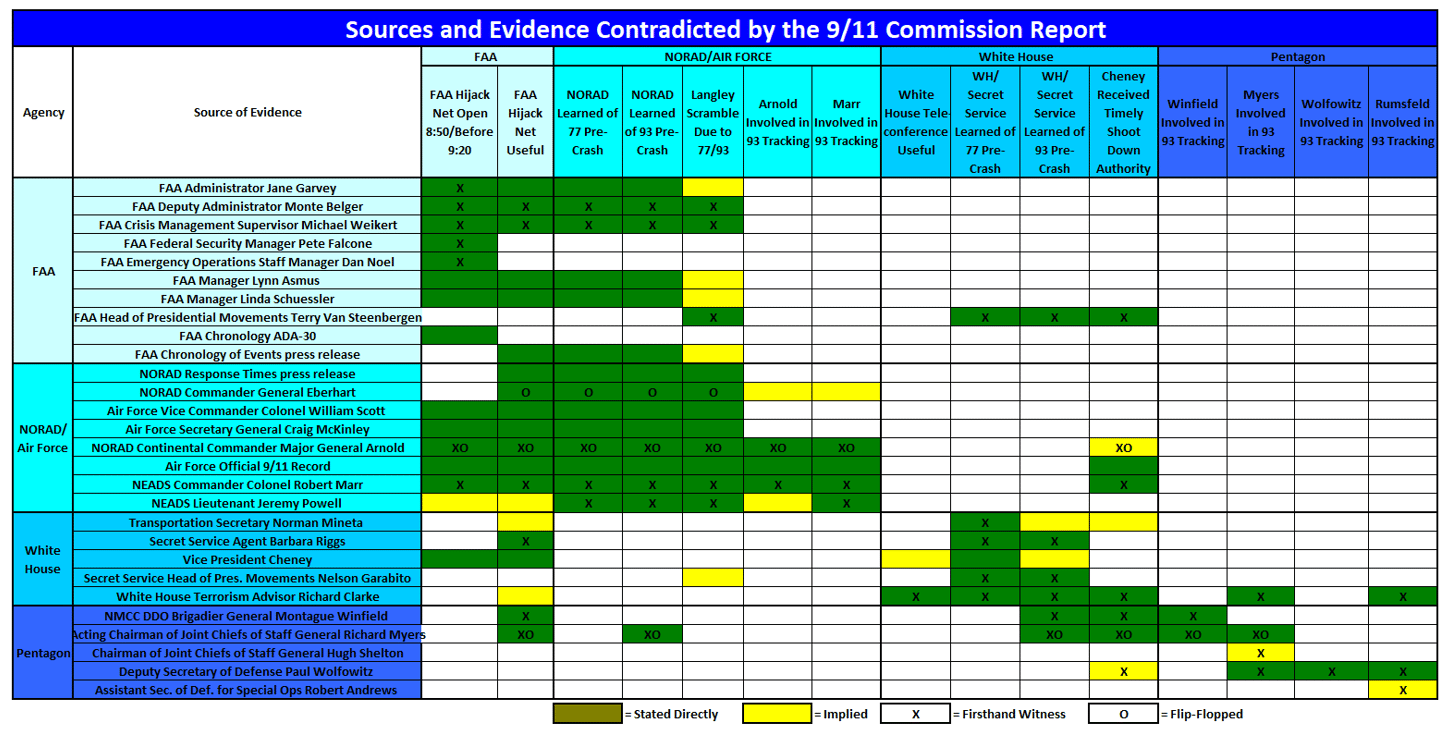
Now, let’s distill these accounts into nine key assertions:
Timely, useful information concerning Flights 77 and 93 was shared by the FAA over the hijack net.
Timely, useful information concerning Flights 77 and 93 was shared by the FAA over the White House teleconference.
The military learned that Flight 77 was hijacked before it crashed.
The military learned that Flight 93 was hijacked before it crashed.
The 9:24 Langley scramble was in response to information shared by the FAA with the military regarding Flights 77 and 93.
Brigadier General Winfield was the NMCC Deputy Director of Operations during the attacks and was involved in timely efforts inside the NMCC to track Flight 93 before it crashed.
Acting Chairmen of the Joint Chiefs of Staff General Richard Myers joined the White House teleconference and was involved in timely efforts inside the NMCC to track Flight 93 before it crashed.
Defense Secretary Donald Rumsfeld joined the White House teleconference and was involved in timely efforts to track Flight 93 before it crashed.
Vice President Cheney was in the PEOC well in advance of Flight 77’s approach to Washington D.C. He received and passed on presidential shoot-down authorization prior to the Flight 93 crashing. And he was involved in timely efforts to track Flight 93 before it crashed.
However, the 9/11 Commission Report asserted that virtually every detail of every one of these accounts was false. Specifically, the 9/11 Commission claimed:
No timely, useful information concerning Flights 77 and 93 was shared by the FAA over the hijack net (pg. 36).
No timely, useful information concerning Flights 77 and 93 was shared by the FAA over the White House teleconference (pg. 36).
The military did not learn that Flight 77 was hijacked before it crashed.
The military did not learn that Flight 93 was hijacked before it crashed.
The 9:24 Langley scramble was not in response to Flight 77 or 93, but to an erroneous report that Flight 11 did not hit the WTC North Tower at 8:46, but continued on toward Washington D.C. (pg. 34).
Brigadier General Winfield was not the NMCC Deputy Director of Operations during the attacks and was not involved in timely efforts inside the NMCC to track Flight 93 before it crashed (pgs. 37, 447, 463 (FN 192)).
Acting Chairmen of the Joint Chiefs of Staff General Richard Myers did not join the White House teleconference and was not involved in timely efforts inside the NMCC to track Flight 93 before it crashed (pg. 38).
Defense Secretary Donald Rumsfeld did not join the White House teleconference and was not involved in timely efforts to track Flight 93 before it crashed (pg. 38).
Vice President Cheney did not enter the PEOC until about 10 AM. He did not receive or pass presidential shoot-down authorization until after Flight 93 crashed. He was not involved in timely efforts to track Flight 93 before it crashed (pg. 40).
In the following chapters, we will step through each of these claims.
Sources:
ABC News, 9/11/2002, “9/11: Interviews by Peter Jennings” (Interviews of Transportation Secretary Mineta, Army Brigadier General Montague Winfield, NEADS Commander Colonel Marr)
ABC News, 11/29/2003, “Cheney Wields Unprecedented V.P. Power” (includes excerpts of Richard Clarke interview by Ted Koppel)
Cornell University, Spring 2006 Alumni Newsletter, “President’s Council of Cornell Women: Spotlight On: [Deputy Director of the Secret Service] Barbara Riggs”
Drs. Alfred Goldberg and Rebecca Cameron, 4/19/2001, “Pentagon Attack Interview with Paul Wolfowitz” (transcript)
FAA, 8/12/2002, “Fact Sheet: Chronology of Events on September 11, 2001 (August 2002)”
General Hugh Shelton, 2009, “Without Hesitation: The Odyssey of an American Warrior,” pgs. 432-33
Leslie Filson, 2003, “Air War Over America: Sept. 11 Alters Face of Air Defense Mission,” pgs. 59, 63, 68, 71-73, published by Tyndall Air Force Base Public Affairs Office
MSNBC, 9/11/2002, “Norman Mineta 9/11 Interview” by Robert Hager
Naval Post Graduate School Newsletter, Volume 1, Issue 10, September 2004, “Special Operations Policy Expert and Veteran Robert Andrews Gives Distinguished Visiting Guest Lectures at NPS”
New York Times, 9/15/2001, “AFTER THE ATTACKS: SKY RULES; Pentagon Tracked Deadly Jet But Found No Way to Stop It”
New York Times, 9/16/2001, “Text of Vice President Cheney's Remarks on ‘Meet the Press’”
Newhouse News Service, 3/31/2005, “Commander of 9/11 Air Defenses Retires”
NORAD, 9/18/2001, “NORAD’S Response Times, Sept. 11, 2001” (press release)
PBS News, 9/14/2001, “Deputy Secretary Wolfowitz Interview with PBS NewsHour”
Richard Clarke, March 2004, “Against All Enemies: Inside America’s War on Terror,” (pgs. 1-8)
General Richard Myers, 2009, “Eyes on the Horizon: Serving on the Front Lines of National Security,” pgs. 151-152
U.S. Congress; Senate Armed Services Committee, 9/13/2001, “U.S. Senator Carl Levin (D-MI) Holds Hearing On Nomination of General Richard Myers to be Chairman of The Joint Chiefs of Staff”
U.S. Congress, 10/25/2001, “Senate Armed Services Committee Holds Hearing on Role of Defense Department in Homeland Security” (Transcript: NORAD Commander Eberhart testimony)
9/11 Commission, 5/23/2003, Public Hearing (Transcript: Commissioner Ben-Veniste reading FAA document entitled, “FAA Communications with NORAD on September 11th, 2001,” prepared by FAA Administrator Jane Garvey, Mr. Asmus, Ms. Schuessler)
9/11 Commission, 5/23/2003, Public Hearing (Transcript: Transportation Secretary Norman Mineta, Colonel William Scott, Major General Craig McKinley, Major General Larry Arnold Testimonies)
9/11 Commission, 9/28/2003, “USSS Statements and Interview Reports” (contains Nelson Garabito’s statement and interview notes)
9/11 Commission, 10/27/2003, “Memorandum for the Record: Interview of Lt. Jeremy Powell”
9/11 Commission, 1/23/2004, “Memorandum for the Record: Interview of NEADS Commander Colonel Robert Marr”
9/11 Commission, 3/30/2004, “Memorandum for the Record: Interview with Terry Van Steenbergen”
9/11 Commission, 4/20/2004, “Memorandum for the Record: Interview with [FAA Deputy Administrator] Monte Belger”
9/11 Commission, 5/7/2004, “Memorandum for the Record: Interview with [FAA Crisis Management Supervisor] Michael Weikert”
9/11 Commission, 6/17/2004, Public Hearing (Transcript: FAA Deputy Administrator Monte Belger Testimony)
9/11 Commission, July 2004, “9/11 Commission Report,” pgs. 39
9/11 Commission, 7/29/2004, untitled letter from the Commissioners and Executive Director Philip Zelikow to DoD Inspector General Joseph Schmitz and DoT Inspector General Kenneth Mead (includes Colonel Marr’s e-mail to Colonel Scott)