CHAPTER 8 - THE FLIGHT 77 ALERT
Summary
As we have seen, the 9/11 Commission rejected broad agreement amongst FAA/NORAD/White House/Secret Service/Pentagon sources – in addition to media reports (NYT, Newsday, WAPO) – concerning the military’s early notification of Flight 77. Instead, the 9/11 Commission claimed the military never heard Flight 77 was hijacked until after it hit the Pentagon (Com-pg. 25-26, 34).
To support its position, the 9/11 Commission cited one 9:34 call in which a Washington controller told a NEADS technician Flight 77 was lost (Com-pg. 27). This call by itself did not come close to proving all other sources were inaccurate, particularly the highly detailed, sourced-cited testimonies of Colonel Scott and Major General McKinley (Com-Scott Test, Com-McKinley Test) and the harmonious firsthand accounts of NORADS’ entire command chain – Continental Commander Major General Larry Arnold, NEADS Commander Colonel Marr, and NEADS technician Jeremy Powell – that the 9:24 Langley scramble was precipitated by FAA reports of both Flight 77 and Flight 93 (Com-Arnold Test, Com-Marr MFR, Com-Powell MFR, Com-OIG Letter). Nevertheless, the 9/11 Commission publicly released the one phone call that supported its narrative and withheld all contradictory evidence cited (Rutgers, NYT).
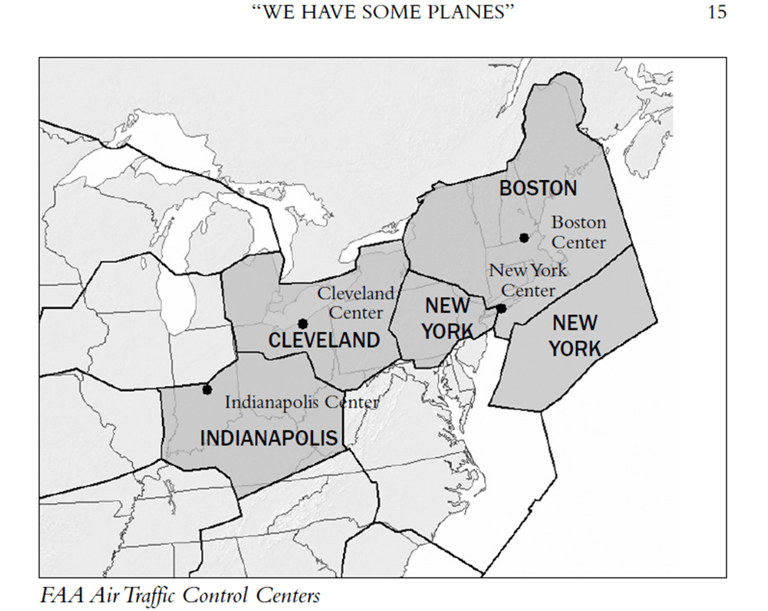
The 9/11 Commission used unknown, non-credentialed contractors to review all FAA documents, transcripts, and tape recordings related to Flight 77 (Com-pg. 460 FN 144). It then generated zero documentation of interviews with these contractors insofar as their names (John and Charles Thomas) are listed nowhere in the 9/11 Commission’s online MFR (Memoranda for the Record) archives (National Archives) or in its 145-page “Finding Aid” which purports to list all interview subjects and materials (Com-Finding Aid). It also blatantly sought to draw attention away from the FAA’s Washington region through which Flight 77 traveled for most of its 36-minute approach to Washington D.C. First, it spent several paragraphs going into detail about what Indianapolis controllers were thinking and doing after Flight 77’s transponder turned off, but never once mentioned the Washington flight controllers in whose region Flight 77 traveled (Com-pg. 25-26). Second, its FAA Air Traffic Control Center map left the Washington Center’s entire region unshaded and unlabeled, in contrast to every other northeast Air Traffic Control region where hijacked planes flew on 9/11 (Com-pg. 15).
Sources:
National Archives Website, “9/11 Commission Memoranda for the Record (MFRs)”
New York Times, 9/15/2001, “AFTER THE ATTACKS: SKY RULES; Pentagon Tracked Deadly Jet But Found No Way to Stop It”
New York Times, 9/7/2011, “Newly Published Audio Provides Real-Time View of 9/11 Attacks”
Newsday, 9/23/2001, “Air Attack on Pentagon Indicates Weaknesses”
Rutgers University Law Review, 9/7/2011, “Full Audio Transcript”
Washington Post, 9/12/2001, “Timeline in Terrorist Attacks of Sept. 11, 2001”
9/11 Commission, 5/23/2003, Public Hearing (Transcript: Colonel William Scott, Major General Craig McKinley, Major General Larry Arnold Testimonies)
9/11 Commission, 10/27/2003, “Memorandum for the Record: Interview of Lt. Jeremy Powell”
9/11 Commission, 1/23/2004, “Memorandum for the Record: Interview of NEADS Commander Colonel Robert Marr”
9/11 Commission, July 2004, “9/11 Commission Report,” pgs. 15, 25-27, 34, 460 (Ch. 1 Footnote 144)
9/11 Commission, undated, “The National Commission on Terrorist Attacks Upon the United States; Finding Aid: Series Descriptions and Folder Title Lists”
9/11 Commission, 7/29/2004, untitled letter from the Commissioners and Executive Director Philip Zelikow to DoD Inspector General Joseph Schmitz and DoT Inspector General Kenneth Mead (includes Colonel Marr’s e-mail to Colonel Scott)
9/11 Commission Rejects Evidence of Military’s Awareness of Flight 77, Cites One Phone Call that Does Not Prove Its Narrative, Outsources Review of Flight 77 Evidence to Non-Credentialed Third Parties, Obscures FAA Region Through Which Flight 77 Traveled
We previously saw that numerous sources confirmed that the FAA informed the military of Flight 77’s hijack before it crashed. Several FAA and military sources stated this directly (Garvey, Belger (firsthand witness), Weikert (firsthand witness), Asmus, Schuessler, Steenbergen (firsthand witness), FAA, NORAD, Eberhart, Scott, McKinley, Arnold (firsthand witness), Air Force, Marr (firsthand witness), Powell (firsthand witness)). Additionally, White House/Secret sources (Mineta (firsthand witness), Riggs (firsthand witness), Cheney, Garabito (firsthand witness), Clarke (firsthand witness)) said the FAA shared pre-impact Flight 77 tracking/hijacking information with them, which strongly suggested the same would have been shared with the military.
In fact, we saw that NORAD’s entire command chain – Continental Commander Major General Larry Arnold, NEADS Commander Colonel Marr, and NEADS technician Jeremy Powell – all agreed that the 9:24 Langley scramble was precipitated by FAA reports of both Flight 93 and Flight 77.
Further, as a reminder, Colonel Scott and Major General McKinley testified to the following:
“At 9:09… at about that same time, kind of way out in the West, is when America 77, which in the meantime has turned off its transponder and turned left back toward Washington, appears back in radar coverage. And my understanding is the FAA controllers now are beginning to pick up primary skin paints on an airplane, and they don't know exactly whether that is 77, and they are asking a lot of people whether it is, including a C-130 that is westbound toward Ohio…
At 9:24 the FAA reports a possible hijack of 77. That's sometime after they had been tracking this primary target. And at that moment as well is when the Langley F-16s were scrambled out of Langley.
At 9:25, America 77 is reported headed towards Washington, D.C., not exactly precise information, just general information across the chat logs… At 9:30 the Langley F-16s are airborne. They are 105 miles away from the Washington area…”
The statement about Flight 77 being “reported headed towards Washington… across the chat logs” was also corroborated in the FAA’s data package publicly released less than a week after 9/11 on September 17, 2001. It contained a 9:25 entry which stated:
“…based on personnel statements from Dulles [Washington] Terminal Radar Approach Control (IAD). Several lAD controllers working radar positions in the facility observed a primary radar target tracking eastbound at a high rate of speed… [which] was later confirmed to be AAL77.”
Early media reports echoed these accounts. A few days after 9/11 the New York Times ran an article that quoted numerous FAA and military officials. At one point the article stated:
“During the hour or so that American Airlines Flight 77 was under the control of hijackers, up to the moment it struck the west side of the Pentagon, military officials in a command center on the east side of the building were urgently talking to law enforcement and air traffic control officials about what to do.”
Also, two weeks after 9/11, Newsday constructed a timeline very similar (albeit five minutes off) to one testified to by Colonel Scott and Major General McKinley. The article explained that Washington Center regional flight controllers in Leesburg, Virginia routinely “handed off” Flight 77 to Indianapolis Center flight controllers as it switched regions, but then saw Flight 77 reappear as an unidentified blip on primary radar at 9:05. It stated:
“After losing track of Flight 77 for about 10 minutes, the FAA rediscovered the plane heading east over West Virginia…”
“[Flight 77] was routinely ‘handed off’ by Leesburg to the next air traffic control center, outside Indianapolis… Then Flight 77 began to turn slightly – and abruptly disappeared from the radar screens. Suddenly there was no transponder signal… Back in Leesburg, air traffic controllers knew at about 9:05 a.m. that they had a new eastbound plane on their radar, but they didn't know it was Flight 77. The aircraft had entered their airspace with no radio contact and no transponder identification.”
Likewise, the day after 9/11, the Washington Post published a timeline that included the following entry:
“9:10 a.m.: Flight 77 was detected by radar in West Virginia, heading east.”
Nevertheless, the 9/11 Commission claimed that FAA never detected Flight 77 during its entire approach to Washington D.C. through regional airspace and it never alerted the military to the Flight 77 hijack before it hit Pentagon at 9:37. The 9/11 Commission Report stated:
“American 77… crossed into the western portion of Washington Center’s airspace at 9:10… [and] traveled undetected for 36 minutes on a course heading due east for Washington D.C.” (pg. 25)
“NORAD heard nothing about the search for American 77.” (pg. 26)
“In… public testimony, NORAD officials stated that at 9:24, NEADS received notification of the hijacking of American 77. This statement was also incorrect… NEADS never received notice that American 77 was hijacked.” (pg. 34)
(Take note that while the first two statements refer specifically to NORAD and NEADS (the Northeastern sector of NORAD), they are under bold headings which state: “Military Notification and Response.” Therefore, the implication is that no military personnel heard of the Flight 77 hijack before it crashed, regardless of whether they were at NEADS, other NORAD facilities, the NMCC/Pentagon, White House, or whether participated in the FAA hijack net or White House teleconference.)
To support its narrative, the 9/11 Commission on page 27 quoted an informal, out-of-protocol phone call in which a Washington controller told a NEADS technician that Flight 77 was “lost” (as opposed to hijacked) at 9:34 and said this was the military’s first alert to Flight 77, which hit the Pentagon at 9:37.
This quotation by itself did not come close to debunking the broad agreement between FAA/NORAD/Secret Service/White House sources we have covered about the content of the FAA’s hijack net and the White House teleconference. Nor did it debunk the Washington Center flight controller activities cited by Colonel Scott, Major General McKinley, and the FAA data package – activities that presumably were related through the hijack net, since the Washington Center participated in it, per the document provided to the 9/11 Commission by Garvey, Asmus, Schuessler. As a reminder, the document stated:
“The FAA shared real-time information on the phone bridges about the unfolding events, including information about loss of communication with aircraft, loss of transponder signals, unauthorized changes in course, and other actions being taken by all the flights of interest, including Flight 77.”
“Other parties on the phone bridges in turn shared information about actions they were taken. NORAD logs indicate that the FAA made formal notification about American Flight 77 at 9:24 a.m. But information about the flight was conveyed continuously during the phone bridges before the formal notification.”
The 9/11 Commission eventually released to the public (via Rutgers Law School and the New York Times) in 2011 the 9:34 audio clip and transcript that appeared to support its narrative while keeping withholding all other Washington controller audio clips and transcripts cited by Scott/McKinley and Garvey which purportedly would have debunked their narrative.
Perhaps in anticipation of objections to the claim that Flight 77 traveled for over half an hour across the Washington region – one of the most highly monitored airspaces in the world – without ever being detected, the 9/11 Commission Report included one of its most bizarre and important footnotes. Footnote 144 on page 460 states:
“John Thomas interview (May 4, 2004); Charles Thomas interview (May 4, 2004). We have reviewed all FAA documents, transcripts, and tape recordings related to American 77… Review of the same materials also indicates that no one within FAA located American 77 until the aircraft was identified by Dulles controllers at 9:32. For much of that time, American 77 was traveling through Washington Center’s airspace. Washington Center’s controllers were looking for the flight, but they were not told to look for primary radar returns.”
Why is this footnote bizarre? The statements it contains are based on interviews with John and Charles Thomas. No titles are given. There are no staff members or commissioners by this name. Neither of these names appears anywhere in the 9/11 Commission’s online MFR (Memoranda for the Record) archives. Nor do they appear in its 145-page “Finding Aid” which purports to list all interview subjects and materials.
Therefore, it appears the 9/11 Commission hired two contractors with unknown credentials and tasked them with reviewing all FAA documents, transcripts, and tape recordings related to American 77 – presumably several hundred or thousands of hours of labor. It then accepted their word that no one in the FAA noticed Flight 77 on primary radar for over half an hour in the middle of the 9/11 attacks as it traveled through one of the most highly monitored airspaces in the world. Finally, it neglected to produce a single sentence of documentation from these all-important interviews, save this footnote.
Furthermore, it is outrageous to claim that not one Washington controller in the middle of a known terrorist attack involving aircraft noticed anything unusual transpiring on primary radar just because they were purportedly “not told to look for primary radar returns,” according to John and Charles. Air traffic controllers routinely rely on both primary and secondary radar, per the FAA’s official Aeronautical Information Manual (Chapter 4, “Section 5. Surveillance Systems.”), which is available online. (Primary radar returns provide air traffic controllers with the approximate longitude and latitude position of an aircraft regardless of whether its transponder is turned on. Secondary radar detects transponder signals to additionally provide an aircraft’s altitude and identity.)
Considering that false testimony before congress carries the threat of imprisonment, the highly detailed testimony of Colonel Scott and Major General McKinley along with all the other testimonies/accounts we have covered carry far more weight than the undocumented assessments of John and Charles and one publicized Washington controller comment to a NEADS technician that does not conclusively disprove anything.
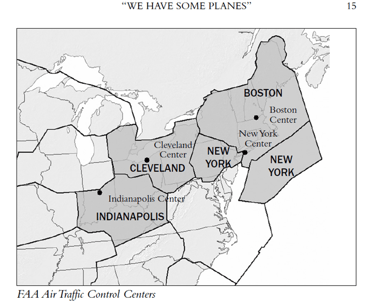
Further, the 9/11 Commission Report clearly sought to draw attention away from the FAA’s Washington Center. First, pages 25 and 26 spent several paragraphs going into some detail about what Indianapolis controllers were thinking and doing after Flight 77’s transponder turned off, but never once mentioned the Washington flight controllers in whose region Flight 77 traveled. Second, the “FAA Air Traffic Control Centers” map on page 15 left the Washington Center’s entire region unshaded and unlabeled, in contrast to every other northeast Air Traffic Control region where hijacked planes flew that day. Here’s a screenshot from page 15.
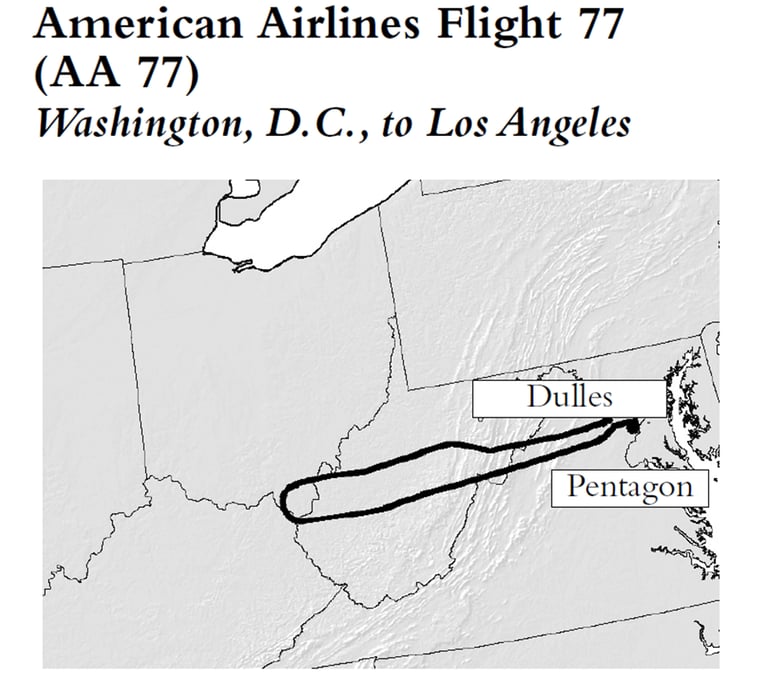
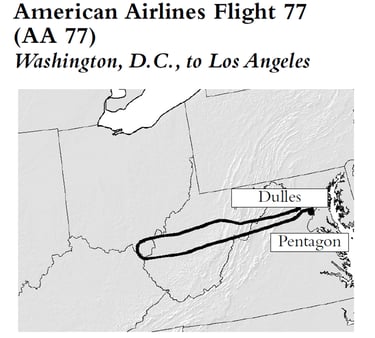
The ridiculousness of this omission is even more glaring when the reader compares this map to the “American Airlines Flight 77” flight path image on page 33. Flight 77 clearly spent much of its post-hijack flight within the Washington Center’s region. Here’s a screenshot from page 33:
Sources:
FAA, “Aeronautical Information Manual, Chapter 4, Section 5. Surveillance Systems.” (available online)
FAA, 9/17/2001, “Summary of Air Traffic Hijack Events: September 11, 2001.”
National Archives Website, “9/11 Commission Memoranda for the Record (MFRs)”
New York Times, 9/15/2001, “AFTER THE ATTACKS: SKY RULES; Pentagon Tracked Deadly Jet But Found No Way to Stop It”
New York Times, 9/7/2011, “Newly Published Audio Provides Real-Time View of 9/11 Attacks”
Newsday, 9/23/2001, “Air Attack on Pentagon Indicates Weaknesses”
Rutgers University Law Review, 9/7/2011, “Full Audio Transcript”
Washington Post, 9/12/2001, “Timeline in Terrorist Attacks of Sept. 11, 2001”
9/11 Commission, 5/23/2003, Public Hearing (Transcript: Colonel William Scott, Major General Craig McKinley, Major General Larry Arnold)
9/11 Commission, 5/23/2003, Public Hearing (Transcript: Commissioner Ben-Veniste reading FAA document entitled, “FAA Communications with NORAD on September 11th, 2001,” prepared by FAA Administrator Jane Garvey, Mr. Asmus, Ms. Schuessler)
9/11 Commission, 10/27/2003, “Memorandum for the Record: Interview of Lt. Jeremy Powell”
9/11 Commission, 1/23/2004, “Memorandum for the Record: Interview of NEADS Commander Colonel Robert Marr”
9/11 Commission, July 2004, “9/11 Commission Report,” pgs. 15, 25-27, 33-34, 460 (Ch. 1 Footnote 144)
9/11 Commission, 7/29/2004, untitled letter from the Commissioners and Executive Director Philip Zelikow to DoD Inspector General Joseph Schmitz and DoT Inspector General Kenneth Mead (includes Colonel Marr’s e-mail to Colonel Scott)
9/11 Commission, undated, “The National Commission on Terrorist Attacks Upon the United States; Finding Aid: Series Descriptions and Folder Title Lists”